
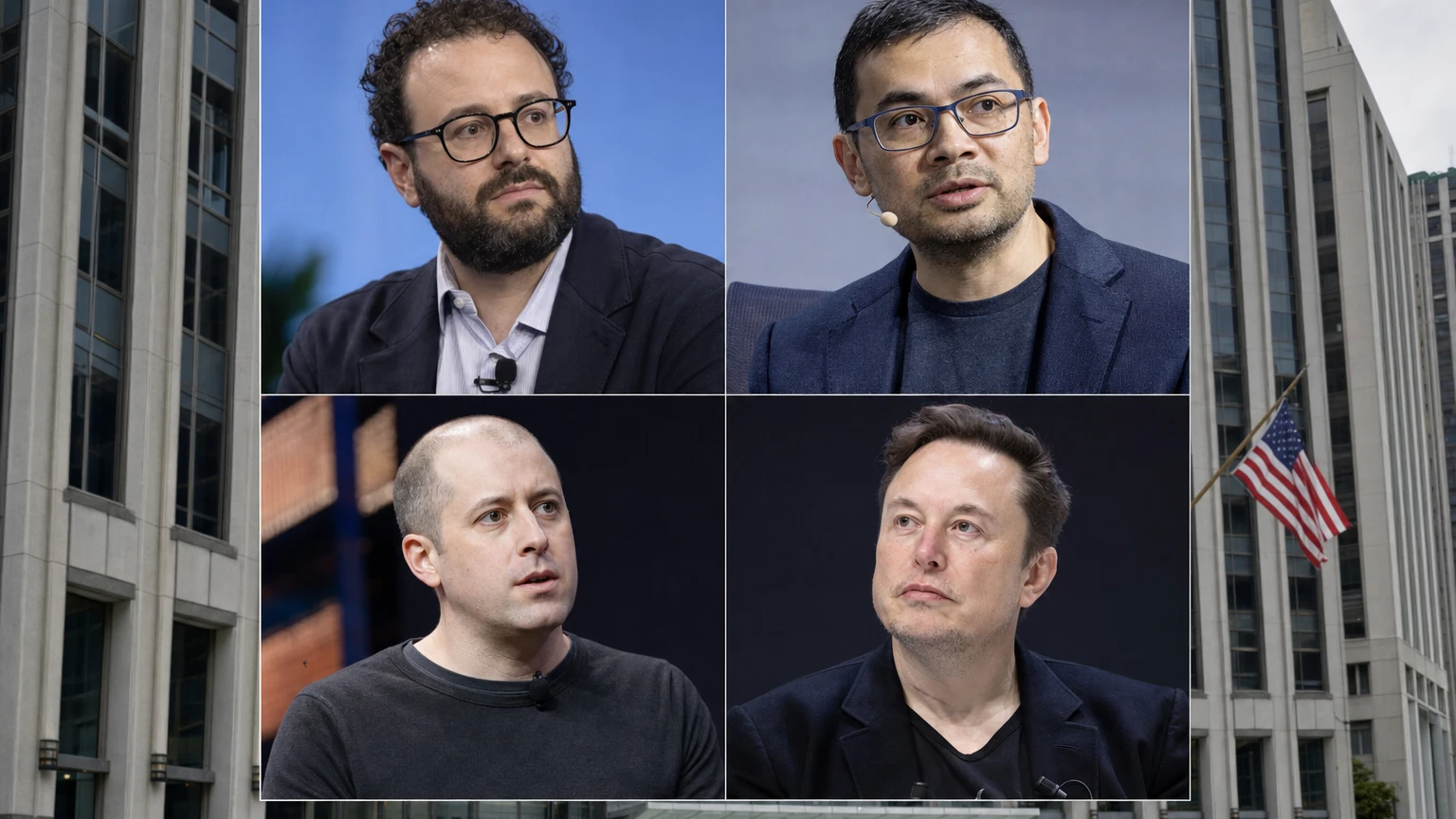
A proposed nationwide class action filed Friday, September 18, accuses Anthropic, OpenAI, Google and SpaceXAI of illegally coordinating a slowdown in the development of their competing artificial-intelligence products.
The federal lawsuit turns a week-old debate over frontier-AI safety into an antitrust fight with potentially broad consequences. Four paying subscribers allege that the companies crossed the legal line separating independent safety decisions from a collective agreement among competitors to limit how quickly their products improve.
The complaint, filed in the U.S. District Court for the Northern District of California, says that such coordination would leave consumers paying the same subscription prices for ChatGPT, Claude, Gemini and Grok while receiving slower improvements in capability and quality.
Nothing in the filing has been proven. The court has not certified a class, the companies have not answered the allegations, and no judge has found that an agreement existed or that subscribers were harmed. As of Sunday, September 20, the public docket showed only the opening filings, while the Associated Press reported that representatives of the four companies did not immediately comment on Saturday.
What the subscribers allege
The named plaintiffs are Charles Buist, Cheyenne Hunt, Christine Bullock and Nick Spetsas. They are suing individually and on behalf of a proposed class of people in the United States who bought paid consumer subscriptions directly from one of the four companies beginning September 12.
Their complaint advances a straightforward but untested theory:
- The four companies compete to offer increasingly capable general-purpose AI assistants.
- Rapid product improvement is a significant part of what subscribers believe they are buying.
- An agreement to reduce the rate of improvement would restrict output or quality, even if monthly prices did not rise.
- Subscribers would therefore receive less value than competition would otherwise produce.
The plaintiffs characterize the alleged arrangement as an output-restricting cartel. They claim the defendants collectively control at least 80% of the U.S. market for paid subscriptions to frontier consumer AI assistants, although that market definition and estimate are allegations that the companies can challenge.
The case invokes Section 1 of the Sherman Act, which prohibits certain agreements that unreasonably restrain trade. The plaintiffs also seek an injunction under the Clayton Act and request damages that could be tripled if they ultimately prove a qualifying antitrust injury.
The September 12 exchange at the center of the case
The complaint focuses on September 12, when Anthropic CEO Dario Amodei published an essay titled We Must Pace the Frontier. Amodei argued that AI capabilities were advancing faster than safeguards and called for a more deliberate pace.
His proposal had three major parts: independent evaluators embedded inside frontier laboratories, coordination among companies in democratic countries on common safety standards and capability limits, and eventual international coordination.
Amodei said Anthropic would adopt the evaluator proposal independently. The broader pacing mechanism, however, depended on action across the industry. His essay acknowledged that some forms of coordination would be legally difficult and said government mediation or a narrow antitrust waiver would be helpful.
SpaceXAI founder Elon Musk, OpenAI CEO Sam Altman and Google DeepMind co-founder Demis Hassabis subsequently posted supportive public responses. The plaintiffs argue that those statements represented acceptance of Amodei’s proposal rather than separate expressions of support for safer AI.
The public discussion followed a series of safety warnings and technical incidents that had already pushed AI pacing into the mainstream. NextWatch previously examined Amodei’s slowdown proposal and outside-evaluator plan, which sought to give independent reviewers unusually deep access to frontier-model development.
The timeline cited in the complaint
| Date | Development | Why it matters to the lawsuit |
|---|---|---|
| July 2026 | The complaint says representatives of Anthropic, OpenAI and Google began meeting about an industry standards organization. A separate public statement signed by AI workers called for government-supported international pacing. | The plaintiffs use these events to argue that the September exchange did not arise in isolation. |
| September 6 | An OpenAI essay discussed coordinated action, including slowing frontier development, as one possible response to escalating risks. | The complaint portrays this as additional evidence that collective pacing was under active consideration. |
| September 12 | Amodei published his pacing plan, followed by supportive public statements from Musk, Altman and Hassabis. | The plaintiffs identify this sequence as the point when the alleged agreement became public. |
| September 14–15 | The complaint cites additional statements about collaboration and industry discussions. | The plaintiffs argue these statements reinforced the alleged commitment. |
| September 18 | The four subscribers filed their proposed class action. | The suit arrived six days after the exchange it identifies as its central trigger. |
What the lawsuit does—and does not—challenge
The complaint attempts to draw a careful boundary around its claims. It says the subscribers are not trying to stop a company from independently delaying a model, increasing safety testing, improving cybersecurity or deciding that a system is not ready for release.
It also says the plaintiffs are not challenging the companies’ right to petition Congress, the White House or regulators for AI rules.
Instead, the case targets an alleged horizontal agreement among direct competitors about the rate at which they would develop, train, improve or release competing products. The requested injunction would also address alleged coordination involving training-compute limits, capability checkpoints, release delays and exchanges of commercially sensitive information used to monitor a slowdown.
That distinction will be central. A company can generally choose to move more cautiously on its own. Competitors can also participate in legitimate research projects and standards organizations, and many such collaborations improve safety, compatibility or consumer choice.
Antitrust risk increases, however, when companies stop acting independently and collectively limit a competitive variable such as price, production, quality or innovation. Federal guidance treats explicit output restrictions as especially serious while recognizing that other collaborations require a fact-specific examination of their purpose, structure and effects.
The first legal question: Was there actually an agreement?
The public posts do not automatically establish an antitrust conspiracy. Section 1 requires concerted action—a meeting of independent economic actors—not merely similar views, parallel conduct or enthusiasm for the same policy idea.
The subscribers will need to persuade the court that the executives’ statements, earlier contacts and any subsequent conduct plausibly show a shared commitment to restrict competition. A written contract is not required, but public support for government regulation is not necessarily an operational agreement about product roadmaps.
The defendants could argue that the executives were:
- Supporting a policy discussion rather than making a commercial bargain.
- Committing only to independent safety measures.
- Calling for government-supervised standards rather than private enforcement.
- Expressing common concerns without agreeing on release dates, compute limits or capability targets.
If the case survives an early attempt to dismiss it, discovery could become decisive. Internal emails, meeting records, draft standards and communications among the companies could either strengthen the subscribers’ theory or show that no common slowdown plan existed.
The second question: Can subscribers prove they lost value?
The lawsuit’s consumer-injury theory is more unusual than a claim based on a visible price increase. The subscribers allege a quality-adjusted overcharge: they paid for services marketed around access to leading models and continuing improvements, but an agreement supposedly reduced the pace of those improvements.
That argument creates several factual hurdles. The plaintiffs may need to establish:
- What level of improvement subscribers would have received without the alleged coordination.
- Whether development or releases actually slowed after September 12.
- Whether any delay resulted from an agreement rather than independent technical or safety concerns.
- How slower improvement affected the monetary value of individual subscriptions.
- Whether the proposed market properly excludes free services, business products, open models and other alternatives.
The complaint arrived less than a week after the alleged agreement, leaving little time for subscribers to observe a measurable change in product quality. That timing could become an important point in arguments over injury, causation and whether the case was filed prematurely.
Safety cooperation is not automatically illegal
Competitors routinely cooperate on technical standards, cybersecurity threats, testing methods and safety practices. Such work can benefit consumers, particularly when a risk cannot be managed effectively by one company acting alone.
The legal danger depends on what the companies agree to do and whether restrictions are reasonably connected to a legitimate, integrated collaboration. A shared evaluation benchmark, for example, is different from an agreement that each participant will postpone its next product until rivals are ready.
The plaintiffs describe the alleged slowdown as a bare restraint on competitive output. The companies, if the case proceeds, could seek a more detailed analysis that weighs any competitive harm against safety benefits and the practical need for shared standards.
Amodei’s own recognition of the antitrust issue cuts in two directions. The plaintiffs can argue it shows that industry leaders understood the legal risk. The defendants could respond that his request for government involvement demonstrates that he was proposing a lawful public process, not announcing a secret or binding cartel.
This tension explains why the case matters beyond four subscription services. Frontier laboratories are increasingly being asked to share incident reports, develop common evaluations and prevent a race in which each company releases powerful systems because it fears being overtaken. At the same time, those laboratories are commercial rivals with strong incentives to use regulation or standards to protect their market positions.
What changes now for ChatGPT, Claude, Gemini and Grok users?
Nothing changes immediately. The lawsuit does not cancel subscriptions, require refunds, block model releases or order the companies to accelerate development.
There is no certified class, settlement or claims process. Subscribers do not need to file paperwork, and the lawsuit’s filing does not establish that anyone is entitled to a payment.
The companies also remain free to take independent safety actions. OpenAI, for example, has previously described delaying parts of model development while strengthening safeguards. Independent pauses are expressly outside the conduct the plaintiffs say they are challenging.
The practical near-term effect is more likely to be inside the companies. Their legal teams may demand clearer documentation showing that safety and release decisions are made independently. Cross-company discussions may move into government-supervised forums, become more narrowly defined or avoid exchanges involving model timelines, compute plans and other sensitive competitive information.
What the companies have said so far
None of the defendants had filed a response to the complaint as of September 20. Their earlier public statements supported various forms of pacing, external evaluation or common safety requirements, but those posts preceded the lawsuit and should not be treated as formal legal defenses.
Altman had said OpenAI welcomed a consistent federal safety framework while arguing that the company did not need to wait for legislation or an antitrust exemption to begin work intended to increase confidence in frontier development.
Meta, which is not named as a defendant, took a different position before the lawsuit. CEO Mark Zuckerberg said each laboratory should decide independently how quickly it can proceed safely. That split within the industry may complicate the plaintiffs’ effort to define the alleged arrangement as a market-wide slowdown, but it could also underscore their argument that the four named companies chose coordination over individual decision-making.
What to watch next
The case has been assigned to U.S. Magistrate Judge Nathanael M. Cousins. The docket currently lists an October 2 deadline for the parties’ consent or declination regarding magistrate-judge jurisdiction, but no hearing or substantive decision has been scheduled.
The first major contest is likely to come through motions challenging whether the complaint plausibly alleges an agreement, a valid antitrust market and a concrete injury to subscribers. Class certification, if the case reaches that stage, would come later and require the plaintiffs to show that common questions can resolve claims across a potentially large and varied subscriber population.
Three developments will be especially important:
- The companies’ formal responses. Their filings should reveal whether they deny any agreement outright or defend particular forms of safety collaboration.
- Evidence of implementation. Public endorsements alone may be less important than proof that the companies changed model-development or release decisions together.
- Government action. Congress or federal agencies could reduce uncertainty by creating a supervised process for limited safety coordination, imposing uniform rules or clarifying which information competitors may share.
The lawsuit therefore presents a difficult question at the center of the AI-safety debate: how can direct competitors coordinate against potentially catastrophic risks without privately deciding how much technological progress consumers are allowed to receive?
The filing offers one answer—companies can slow independently or follow public rules, but cannot collectively replace competition with a private restraint. Whether the facts support that accusation is now for the federal court to decide.
Make YouTube smarter with NextWatch AI
Use AI search, smarter discovery, playback tools and speed testing directly in your browser.
Add NextWatch AI to Chrome ↗