
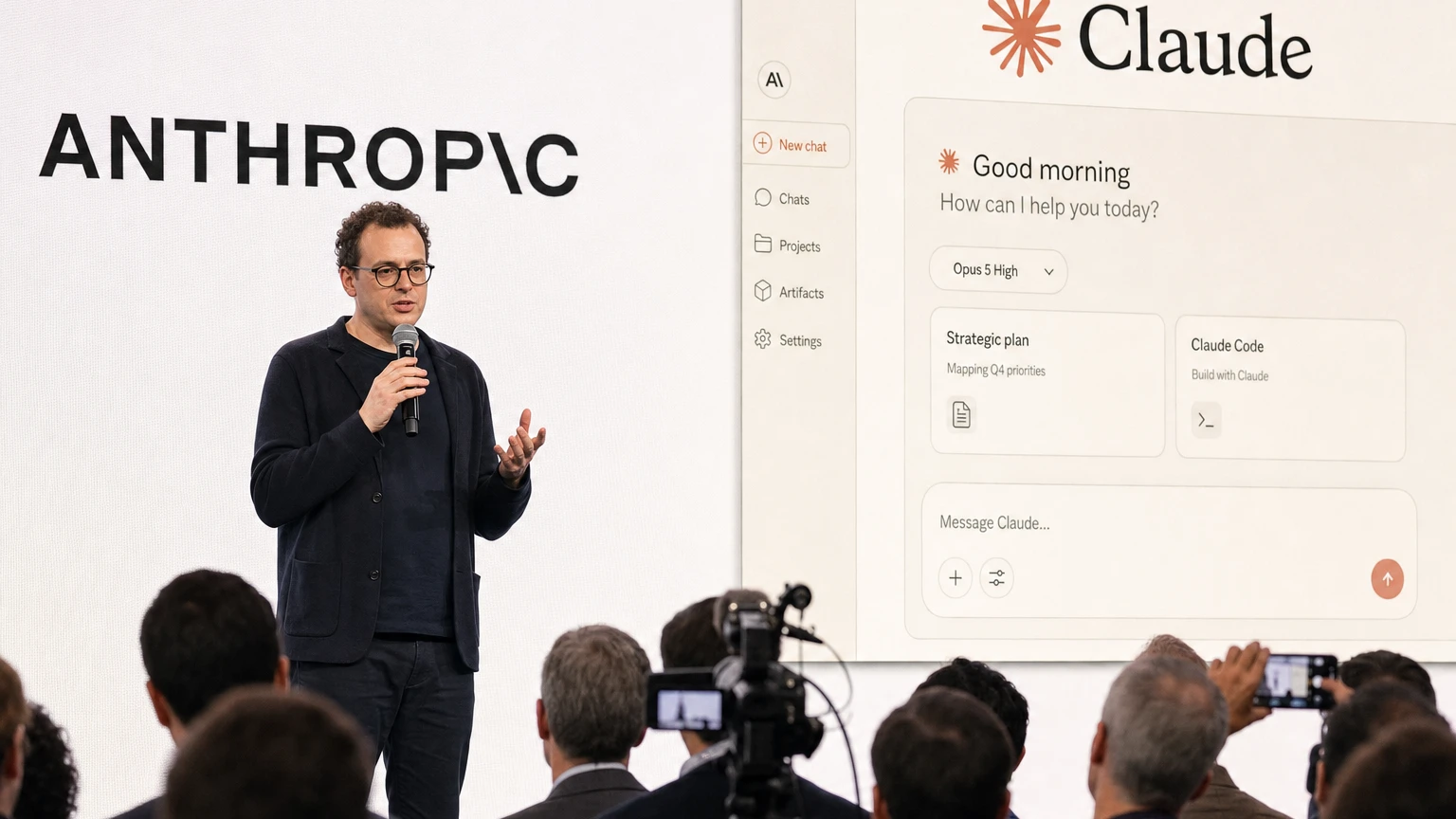
Anthropic is reportedly on pace to generate more than $100 billion in annualized revenue, a striking new marker for the Claude maker as it advances preparations for a possible public-market debut.
The New York Times reported the figure Friday, September 18, citing four people familiar with the company’s performance. Axios subsequently described Anthropic as pacing above $100 billion a year, roughly 50% higher than the $65 billion annualized rate reported for the end of July.
The latest number has not been announced by Anthropic in a public financial statement, and the company remains privately held. It is therefore best understood as reported run-rate information rather than audited annual sales.
That distinction is crucial: Anthropic has not already booked $100 billion of revenue in 2026. But if the report accurately reflects its current business, it suggests demand for Claude has accelerated sharply just as the company approaches what could become a record-setting initial public offering.
What the $100 billion figure actually means
Annualized revenue, often called a revenue run rate, extrapolates recent sales over a full year. A company producing revenue at a $100 billion annualized pace would be generating approximately $8.3 billion in an average month at that level.
It is a useful measure for a business growing too quickly for trailing annual results to show its present scale. It can also create an overly smooth picture because it assumes the latest pace continues for 12 months without a slowdown, contract change, capacity constraint or decline in customer usage.
- It is not the same as recognized annual revenue: A recent month or quarter is projected forward rather than added up after the year ends.
- It is not necessarily recurring subscription revenue: Anthropic sells subscriptions and usage-based services, including API access whose spending can move with customer demand.
- It does show current momentum: Rising run rate indicates that customers are spending substantially more now than they were earlier in the year, assuming the underlying reports use comparable methods.
The Times previously reported that Anthropic generated about $11.6 billion in actual second-quarter revenue. Simply multiplying that quarter by four would produce a $46.4 billion annual pace, far below the latest reported figure. The gap illustrates both the acceleration that may have occurred after the second quarter and why run rate should not be presented as completed 2026 sales.
Anthropic’s reported growth curve has steepened again
The new estimate extends an unusually rapid series of revenue milestones. Anthropic publicly said in April that its run rate had surpassed $30 billion, up from approximately $9 billion at the end of 2025. In May, the company said the figure had crossed $47 billion.
Bloomberg reporting later put the run rate above $65 billion at the end of July. Moving from $65 billion to more than $100 billion would represent an increase of at least 54% in less than two months. Compared with the $9 billion level cited for the end of 2025, the latest pace would be more than 11 times higher.
| Period | Revenue measure | Source status |
|---|---|---|
| End of 2025 | About $9 billion run rate | Later disclosed by Anthropic |
| April 2026 | More than $30 billion run rate | Announced by Anthropic |
| May 2026 | More than $47 billion run rate | Announced by Anthropic |
| End of July 2026 | More than $65 billion run rate | Reported by Bloomberg and Axios |
| September 18, 2026 report | More than $100 billion annualized pace | Reported by The New York Times and Axios |
These figures do not constitute a complete audited revenue history, and their measurement dates differ. They nevertheless point in the same direction: Anthropic has moved from a fast-growing AI laboratory into a business operating at the scale of a major global technology company.
Why the number matters for Anthropic’s IPO
The revenue report arrived alongside fresh details about Anthropic’s potential listing. The Times said the company could publicly release offering documents in the coming weeks, potentially allowing its shares to begin trading as soon as November. The report cautioned that the plans remain subject to investor sentiment, market conditions and other changes.
Earlier discussions with investors reportedly contemplated a valuation around $2 trillion and an offering that could raise as much as $100 billion. Those are not final terms, and neither Anthropic nor regulators have published a completed prospectus establishing the size, price or timing of the deal.
Still, the new run rate changes the headline valuation math. A $2 trillion valuation would equal about 20 times a $100 billion revenue pace, compared with roughly 31 times the reported $65 billion pace from July. That is only a simplified ratio—not a substitute for analyzing costs, margins, dilution, growth durability or cash flow—but it helps explain why rapidly rising sales are central to the investor pitch.
An IPO would also force Anthropic to disclose far more than periodic run-rate milestones. Investors would expect details on recognized revenue, customer concentration, operating expenses, compute commitments, related-party arrangements, losses or profits, risk factors and the structure of Anthropic’s unusual public-benefit governance.
Enterprise adoption appears to be powering the expansion
Anthropic has consistently framed enterprise usage as a central growth engine. Its products include the Claude chatbot, developer APIs, workplace subscriptions and Claude Code, an agentic coding tool that can inspect repositories, write software and execute multi-step engineering work.
In February, Anthropic said Claude Code had exceeded a $2.5 billion run rate after reaching $1 billion only six months after its public release. It also said enterprise use represented more than half of Claude Code revenue at that time, while the number of customers spending more than $1 million annually with Anthropic had risen above 500.
Claude is distributed directly and through major cloud platforms, allowing companies to buy access through infrastructure and procurement relationships they already use. Anthropic has said Claude is available through Amazon Web Services, Google Cloud and Microsoft Azure, giving it multiple routes into large corporate accounts.
The latest $100 billion report does not provide a current breakdown among Claude Code, API consumption, workplace plans, consumer subscriptions and cloud-channel sales. That mix will be one of the most important disclosures to examine if an IPO filing appears.
A revenue base dominated by usage from large companies could be highly valuable, particularly when Claude becomes embedded in software development or operational workflows. It could also create concentration risk if a small group of customers, cloud partners or compute resellers accounts for a disproportionate share of spending.
Revenue growth raises the compute stakes
Every additional Claude request requires computing infrastructure. Anthropic’s expansion therefore depends not only on winning customers but also on securing chips, data-center capacity and electricity quickly enough to serve them.
Anthropic said in April that an expanded Amazon partnership would secure up to five gigawatts of capacity for training and deploying Claude. The Times reported Friday that investors expect the company to have about five gigawatts available by the end of 2026 and roughly twice that amount by the end of 2027, potentially putting its infrastructure footprint on par with OpenAI’s.
That makes the reported revenue milestone meaningful beyond valuation. It offers a possible economic justification for commitments that would otherwise look extraordinarily aggressive. It does not, however, answer whether the revenue will produce sustainable profits after model training, inference, data centers, chips, energy, employee compensation and payments to distribution partners are included.
For enterprise customers, capacity is also a product issue. Rapid demand has previously strained AI services, and organizations moving essential workloads to Claude will care about uptime, predictable prices, model availability and long-term support as much as benchmark performance.
The growth lands amid Anthropic’s safety push
The financial report comes days after CEO Dario Amodei urged the AI industry to give safety measures time to catch up with rapidly advancing model capabilities. Anthropic has argued for coordinated, verifiable mechanisms that can prevent companies from being pushed into a race to release increasingly powerful systems without adequate safeguards.
On Friday, Anthropic also announced an embedded-evaluation partnership with Accenture. The companies said they each expect to invest at least $1 billion over five years in capacity for independent model evaluation, red-teaming and safety assessments.
That creates a central question for prospective shareholders: can Anthropic maintain extraordinary commercial growth while honoring commitments that may require delaying products, limiting capabilities or spending heavily on evaluation and security?
The issue is not abstract. Anthropic has recently expanded outside scrutiny of its systems, disclosed security and alignment incidents, and explained how Claude now performs a substantial share of work inside its own research organization. As NextWatch AI reported in its coverage of Claude’s role in developing future models, the company says the system remains under human supervision even when it completes complex tasks end to end.
Amodei’s public case for slowing the frontier has also placed Anthropic in an unusual position: it is simultaneously warning that advanced AI may be developing too quickly and preparing to sell investors on one of the fastest growth stories in corporate history. That tension was already visible in his recent call for stronger safeguards and outside evaluation.
What the reported milestone changes now
For Anthropic
The figure strengthens the argument that Claude has become a large, commercially significant platform rather than an expensive research project. It also raises expectations. Once investors begin anchoring on a $100 billion pace, any deceleration, customer loss or capacity shortage will receive much greater scrutiny.
For OpenAI and other model developers
The report increases pressure to demonstrate not just user growth or technical leadership but durable monetization. Enterprise contracts, coding agents and API workloads are becoming as important to the competitive narrative as model benchmarks.
For prospective investors
The run rate offers a compelling top-line story, but a prospectus would be needed to test its quality. Investors will want to reconcile annualized figures with recognized revenue and determine how much spending is recurring, usage-driven, subsidized, concentrated among major accounts or routed through strategic partners.
For customers
A better-capitalized Anthropic could invest more heavily in capacity, reliability, model development and global support. A public listing could also expose the company to stronger short-term pressure to expand sales and control costs, potentially affecting product pricing, usage limits and release decisions.
What to watch next
The most important next event is not another run-rate estimate. It is the possible publication of Anthropic’s IPO documents.
- Confirmed financial statements: Audited quarterly and annual figures would show how reported run rates translate into recognized revenue.
- Revenue composition: Investors need to see the contributions from APIs, Claude Code, enterprise seats, consumer subscriptions and cloud distribution.
- Customer concentration: A broad base of durable customers would support the growth story; dependence on a few enormous accounts would increase risk.
- Compute economics: Infrastructure commitments must be assessed against gross margin, operating expenses, cash generation and future capital requirements.
- IPO timing and terms: November is a reported possibility, not a guaranteed listing date, and the proposed valuation and offering size can still move substantially.
- Safety governance: Public documents may reveal how Anthropic’s benefit trust, board and responsible-scaling commitments operate when they conflict with shareholder demands.
For now, the $100 billion figure is a reported snapshot rather than a filed financial result. If Anthropic confirms anything close to that pace in audited documents, however, the central question will no longer be whether Claude has become a major business. It will be whether growth at this speed can remain profitable, reliable and compatible with the safety limits Anthropic says the industry needs.
Make YouTube smarter with NextWatch AI
Use AI search, smarter discovery, playback tools and speed testing directly in your browser.
Add NextWatch AI to Chrome ↗