
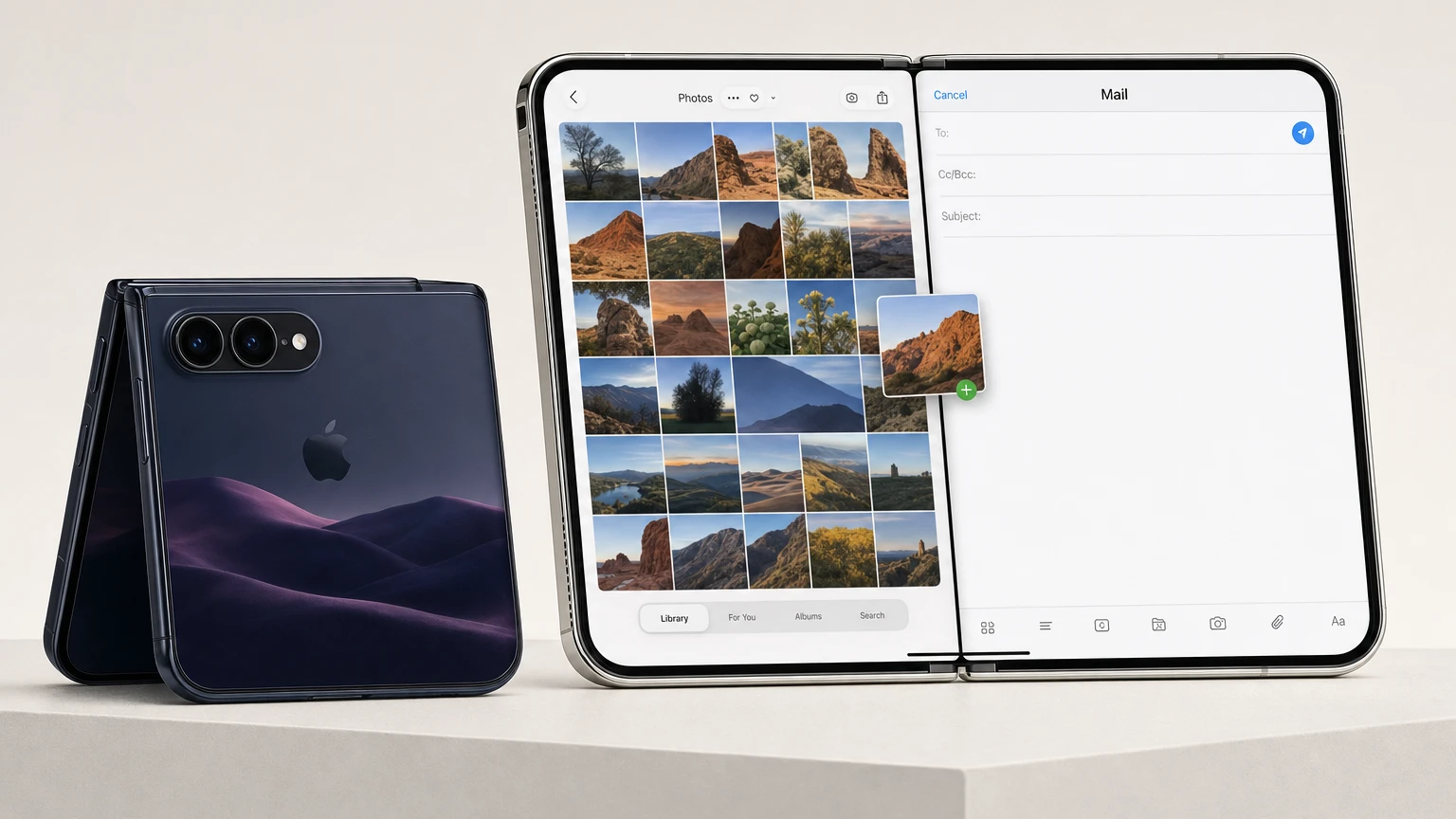
Apple unveiled the iPhone Duo on Wednesday, September 9, introducing its first foldable phone and the biggest physical redesign of the iPhone in years. The device starts at $1,999, combines a 5.4-inch outer screen with a 7.6-inch folding display, and will reach stores on Friday, October 23.
The most important detail for buyers is that the Duo does not follow the iPhone 18 Pro’s September launch schedule. Apple will open iPhone Duo preorders at 5 a.m. Pacific on Friday, October 16, more than a month after iPhone 18 Pro preorders begin. Anyone expecting to order Apple’s foldable on September 12 will be too early.
The Duo matters because Apple is doing more than adding a hinge. It has redesigned parts of iOS around two displays, introduced side-by-side app multitasking on an iPhone, brought back Touch ID for its most expensive handset and made support for Apple Pencil part of the roadmap. But the $1,999 price does not buy every feature found on the less expensive iPhone 18 Pro models, particularly in the camera system.
iPhone Duo price, screens and release date at a glance
| Detail | iPhone Duo |
|---|---|
| Announcement | September 9, 2026 |
| Preorders | October 16 at 5 a.m. Pacific |
| U.S. release date | October 23 |
| Starting price | $1,999 for 256GB |
| Storage | 256GB, 512GB, 1TB or 2TB |
| Outer display | 5.4-inch OLED, up to 120Hz |
| Inner display | 7.6-inch folding OLED, up to 120Hz |
| Processor | A20 Pro |
| Rear cameras | 48MP main and 48MP ultrawide |
| Weight | 254 grams |
| Thickness | 5.2mm open; 11.3mm closed |
| Software at launch | iOS 27.1 |
| Colors | Star White and Night Sky |
The real iPhone Duo preorder and availability timeline
Apple is separating the Duo from its normal September iPhone rollout. The iPhone 18 Pro and iPhone 18 Pro Max become available to preorder on Saturday, September 12, with sales beginning September 18. The foldable will remain unavailable for another five weeks.
- September 12: iPhone 18 Pro and Pro Max preorders begin.
- September 18: iPhone 18 Pro and Pro Max reach stores.
- October 16: iPhone Duo preorders open at 5 a.m. Pacific.
- October 23: iPhone Duo becomes available in the U.S. and more than 70 other countries and regions.
- October 30: Duo availability expands to 28 additional markets.
The later date gives Apple and outside developers additional time to prepare software for the new display shape. It also means early iPhone 18 Pro buyers will have to decide before full iPhone Duo reviews, carrier offers and retail demonstrations are widely available.
What changes when an iPhone can open into a larger screen
The Duo is a small phone and a large phone at different moments
Closed, the Duo is unusually short and relatively wide. It measures 4.64 inches tall and 3.31 inches wide, compared with 6.43 by 3.07 inches for the iPhone 18 Pro Max. That should make the Duo feel less like a tall slab and more like a compact, book-shaped object in a pocket or hand.
The 5.4-inch outer screen is smaller diagonally than the 6.3-inch iPhone 18 Pro display. Apple nevertheless says it provides 90% of the Pro’s screen area because of its different proportions. It is intended for messaging, calls, maps, music controls and other tasks that do not require opening the device.
Unfolding the phone reveals a 7.6-inch display that Apple says offers 50% more screen area than the 6.9-inch iPhone 18 Pro Max. Both Duo screens support adaptive refresh rates up to 120Hz, Always-On functionality and up to 3,000 nits of claimed peak outdoor brightness.
The larger panel will not make every video fill all 7.6 inches. The inner screen is closer to a compact tablet shape than a conventional widescreen television, so many movies and videos will retain bars around the image. The extra space should be more transformative for webpages, documents, photos, games and apps used side by side.
Split View comes to the iPhone
The most consequential software addition is Split View. Users can place two apps next to each other, switch either side independently and save app pairings for later. Apple also allows two windows from the same app, including separate Safari windows for comparing products, travel options or research material.
Siri AI can occupy one side while the related email, webpage, photo or document remains visible on the other. This is the clearest practical difference between Duo and a standard iPhone: users no longer have to replace one full-screen app with another every time they need information from a second source.
Apple has moved interface elements including app controls, the Dock, status information and Dynamic Island components toward the sides of the display to preserve vertical space. The Home Screen can show two pages at once when the phone is open, and the interface changes as the device is rotated, folded or turned over.
Apple says apps built with standard system components and resizing support should adapt with limited work. That does not guarantee that every app will look ideal on launch day. Games, video services and apps with highly customized interfaces may need updates to use the full screen properly. Older or unoptimized software can still run, but the experience may include unused space rather than a layout designed for the Duo.
Apple Pencil support is coming, but not at launch
Apple plans to add support for the USB-C Apple Pencil later in 2026. The stylus will work on either display for handwriting, sketching and document markup, according to the company.
That could make the Duo useful as a pocket notebook, but buyers should not treat Pencil support as an October 23 launch feature. Apple has not supplied a more precise release date beyond later this year, and the Pencil remains a separate accessory.
Touch ID replaces the usual Pro authentication system
The Duo uses a Touch ID sensor built into its side button rather than the Face ID system included with the iPhone 18 Pro. The decision allows authentication to work consistently whether the phone is open, closed or resting partially folded on a surface.
It also marks a notable return for fingerprint authentication on Apple’s flagship phone line. Users can additionally unlock the Duo with an Apple Watch.
The $1,999 Duo is not Apple’s best camera phone
The Duo’s price is $800 higher than the $1,199 iPhone 18 Pro and $700 higher than the $1,299 iPhone 18 Pro Max. That premium pays primarily for the folding display, hinge and specialized software—not a superior camera system.
The Duo has two 48-megapixel rear cameras: a main camera with an optical-quality 2x crop and an ultrawide camera that can also capture macro images. The iPhone 18 Pro models add a dedicated 48-megapixel telephoto camera, longer-range optical-quality zoom, a variable-aperture main camera and additional professional photo and video controls.
For photographers, sports parents and travelers who regularly rely on long zoom, the iPhone 18 Pro may be the stronger choice despite costing substantially less. The Duo can record up to 4K Dolby Vision video at 120 frames per second with its main camera, but its hardware is optimized around flexibility rather than maximum lens range.
The fold does enable camera modes a standard iPhone cannot duplicate. Subjects can see a live preview on the outer screen while someone photographs them with the rear cameras. Owners can also take high-quality rear-camera selfies, prop the phone up without a tripod or show a second participant on the outer display during a FaceTime call.
Battery life and portability involve unexpected tradeoffs
At 254 grams, the Duo weighs only five grams more than the iPhone 18 Pro Max. It is remarkably thin when open at 5.2mm, but folding the two sides together produces an 11.3mm-thick device—about 29% thicker than the Pro Max before adding a case.
Apple rates the Duo for up to 24 hours of typical mixed use. Its video figures vary significantly depending on which screen is active: up to 44 hours on the outer display or 31 hours on the inner display. The iPhone 18 Pro Max is rated for 30 hours of typical use and 45 hours of video playback.
In other words, the Duo can approach Pro Max endurance when it remains closed, but extensive use of the large folding display is likely to consume its battery more quickly. Apple’s dual-battery design places a battery in each half of the device and manages them as one system.
The phone supports wired charging to 50% in around 20 minutes with a sufficiently powerful adapter. MagSafe and Qi2 wireless charging reach up to 25 watts.
How iPhone Duo compares with Samsung and Google foldables
Apple is entering an established premium foldable market rather than creating one. Samsung and Google already have 2026 foldables on sale, and their current models expose some of the Duo’s most significant competitive differences.
| Phone | Starting MSRP | Outer / inner screen | Weight | Notable distinction |
|---|---|---|---|---|
| Apple iPhone Duo | $1,999 | 5.4 / 7.6 inches | 254g | iOS, IP68 and Apple Pencil support planned later in 2026 |
| Samsung Galaxy Z Fold8 | $1,899.99 | 5.5 / 7.6 inches | 201g | Similar compact screen sizes in a device that is 53g lighter |
| Google Pixel 11 Pro Fold | $1,899 | 6.5 / 8 inches | About 238g | Larger displays and a dedicated 5x telephoto camera |
Those are base prices before temporary promotions, carrier credits or trade-ins. At list price, the Duo costs about $100 more than either Android rival.
Samsung’s Galaxy Z Fold8 is the closest match in screen size, but it is dramatically lighter. Google provides larger inner and outer displays, plus a triple-camera system with dedicated telephoto hardware. Both Android phones are already available, giving buyers time to examine them in stores and consult longer-term reviews.
Apple claims an IP68 dust- and water-resistance rating for the Duo, matching Google’s Pixel rating and exceeding the Galaxy Z Fold8’s IP48 designation. That is an important specification for a device with a complex hinge, although an ingress rating cannot show how the inner coating, folding panel or hinge will look after months of daily use.
Early hands-on demonstrations indicate that the Duo still has a center fold, but its nano-texture finish makes the crease less prominent under many lighting conditions. Brief demonstrations cannot establish long-term scratch resistance, hinge reliability or whether the matte inner surface will satisfy users who prefer glossy displays.
Who should consider the iPhone Duo?
The strongest reasons to buy
- You want a folding phone without leaving iOS, iMessage, FaceTime, Apple Watch and the wider Apple ecosystem.
- You regularly compare webpages, reference documents while writing or use two apps together.
- You value a compact closed shape more than the tall dimensions of a Pro Max.
- You want Apple’s largest iPhone workspace and are comfortable paying a first-generation premium.
- You plan to use rear-camera previews, hands-free tabletop modes or future Apple Pencil support.
The strongest reasons to wait or choose an iPhone 18 Pro
- You want Apple’s best camera system, long-range zoom or professional recording controls.
- You prioritize battery life on a single large screen over having two display modes.
- You want a thinner phone when it is closed or a significantly lighter foldable.
- You need Apple Pencil support immediately rather than through a later update.
- You prefer to see independent durability, repairability and app-compatibility testing before spending $1,999.
The central buying decision is therefore not simply whether the Duo is better than the iPhone 18 Pro. The devices prioritize different things. The Pro models remain conventional flagship phones built around cameras, battery life and familiar ergonomics. The Duo charges more to turn the iPhone into a two-mode device that can replace some of the situations in which users would otherwise reach for a tablet.
What to watch before October 23
The first major signal will be software. Apple’s apps are already designed for the Duo, but the quality of the broader experience will depend on how quickly major developers update their layouts for iOS 27.1. Streaming services, games, banking apps, social networks and productivity tools will be especially important tests.
Carrier offers and Apple trade-in values should become clearer closer to October 16. The $1,999 list price is equivalent to $83.29 per month over 24 months before taxes, while Apple has also announced a separate leasing option for eligible U.S. customers.
Independent reviews will need to test battery life while switching between both screens, sustained performance, camera quality against the iPhone 18 Pro, the visibility and feel of the crease, and the durability of the inner display. Supply will also matter: if particular colors or storage capacities are limited, estimated delivery dates could move beyond the October 23 launch soon after preorders begin.
For now, the iPhone Duo is Apple’s clearest argument that the next major iPhone upgrade is not another camera bump or faster processor. It is a different way of using iOS. Whether that change is worth $1,999 will depend less on the novelty of opening the phone and more on how often owners genuinely benefit from what appears on the second half of the screen.
Make YouTube smarter with NextWatch AI
Use AI search, smarter discovery, playback tools and speed testing directly in your browser.
Add NextWatch AI to Chrome ↗