
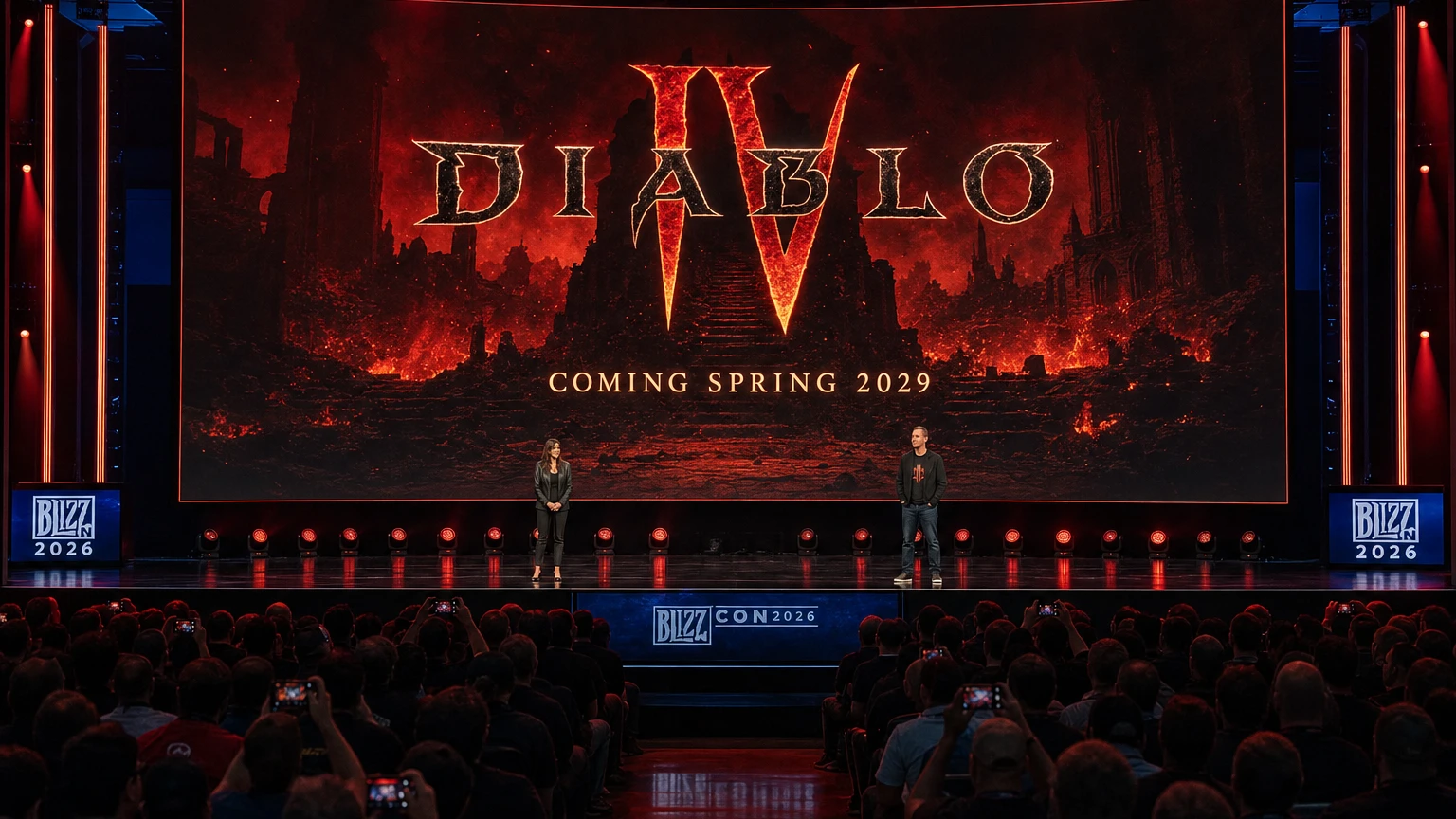
Blizzard Entertainment officially announced Diablo V during the BlizzCon 2026 opening ceremony on Saturday, September 12, setting a spring 2029 release window for the next mainline action RPG. The reveal was followed by an early development panel that identified the first three classes, explained the sequel’s radically altered version of Sanctuary and outlined a return to several Diablo II-inspired loot systems.
The headline premise is unusually definitive for a Diablo opening: the heroes lost, Sanctuary fell and Diablo won. Players will enter a world already controlled and physically reshaped by the Lord of Terror rather than racing to prevent his return.
Blizzard showed a cinematic teaser, not a finished gameplay demonstration, and repeatedly framed the systems discussed at BlizzCon as early work that may change before launch. Even so, the studio disclosed substantially more than a logo and date, including the protagonist’s identity, a mobile caravan that replaces traditional safe towns, procedural world elements and three playable classes.
| Diablo V detail | What Blizzard confirmed |
|---|---|
| Release window | Spring 2029 |
| Story premise | Diablo has conquered Sanctuary and rules from Westmarch |
| Player identity | The Heir to Westmarch, with a mysterious connection to Diablo |
| First classes | Demon Hunter, Monk and the new Plague Knight |
| World structure | A changing procedural landscape with no conventional safe towns |
| Player hub | A growing caravan of survivors, vendors and companions |
| Loot direction | Diablo II-inspired item depth, stat requirements, sets, Runes and Runewords |
| Development updates | Regular progress reports are planned to begin in 2027 |
Diablo is no longer waiting at the end
Diablo V’s biggest narrative change is that its namesake villain will be present from the beginning. Blizzard says Diablo has taken the throne of Westmarch and is using the people and souls of Sanctuary as weapons in the Eternal Conflict, with the conquest serving as a step toward an invasion of the High Heavens.
The player becomes the Heir to Westmarch, fleeing through the burned remains of a kingdom converted into an outpost of Hell. This character has an unexplained connection to Diablo that could provide unusual power while also leaving the hero vulnerable to his influence.
Blizzard’s premise creates a different power dynamic from campaigns built around stopping a demonic plan before it reaches completion. Sanctuary is not approaching an apocalypse; it is trying to survive after one. Some people have joined Diablo’s cults, while others have been corrupted into powerful figures called Dread Commanders.
The game is reportedly set approximately 100 years after Diablo IV. That distance gives Blizzard room to establish a changed civilization while allowing the seasonal story of Diablo IV to help explain how the world eventually reaches this state.
A procedural Sanctuary built to change between visits
Diablo IV adopted a largely fixed open world, but Diablo V is being designed around a less stable Sanctuary. Blizzard says terrain, points of interest, enemies and rewards may change when players return to an area. Developers also discussed procedurally generated dungeons and open regions during the BlizzCon panel.
That direction could restore some of the unpredictability associated with earlier Diablo games without necessarily abandoning the scale of Diablo IV’s connected world. The important distinction is that Blizzard is describing more than randomized dungeon corridors: parts of the wider landscape are intended to reflect Diablo’s continuing transformation of Sanctuary.
The studio has not yet explained how often regions will change, whether all players will see the same configurations or how procedural generation will interact with campaign progression and multiplayer. Those implementation details will determine whether the world feels meaningfully dangerous or merely rearranged.
There are no safe towns, so the hub travels with you
The conquest of Sanctuary also changes one of the series’ most familiar structures. Blizzard says traditional towns and reclaimed strongholds are gone. Players will instead assemble a caravan of survivors that travels across the ruined Western Continent.
Members of the caravan will function as vendors and companions, but Blizzard is also positioning them as characters with personal histories and quests. The early examples include a former Sister of the Sightless Eye and a stranded Treasure Goblin searching for purpose in a world where ordinary greed has become meaningless.
A mobile hub could make the campaign feel more desperate and cohesive than repeatedly teleporting to an untouched city. It may also allow the cast, available services and visual state of the player’s base to evolve together. Blizzard has not said how customizable the caravan will be or what happens if companions are endangered, lost or replaced.
Demon Hunter and Monk return alongside the Plague Knight
Blizzard confirmed three of Diablo V’s playable classes during the development panel. More classes will be announced later, and combat details remain preliminary.
- Demon Hunter: The ranged hunter returns with twin crossbows, rapid movement and attacks delivered from the shadows. Its initial description closely preserves the aggressive hunter fantasy established in Diablo III.
- Monk: Another Diablo III class returns with close-range martial arts and holy abilities. Blizzard describes the Monk as combining physical strikes with divine power.
- Plague Knight: The first newly announced class spreads disease and pestilence across the battlefield, then consumes those effects for power. Its armored appearance and attrition-based theme distinguish it from the series’ traditional poison users.
The lineup immediately signals that Diablo V will not simply carry Diablo IV’s launch roster forward. The return of two Diablo III archetypes, paired with an entirely new class, suggests Blizzard is selecting characters from across the franchise instead of treating the latest game as the sole mechanical foundation.
Important questions remain unanswered, including the total number of launch classes, skill-tree structure, resource systems and whether classes will have restricted weapon types. Blizzard also has not announced whether character specializations will resemble Diablo IV’s systems or take a different approach.
Loot is deliberately looking back to Diablo II
Some of the most concrete mechanical details concern items. Blizzard said its goal is to make gear readable and memorable while retaining enough depth to support hundreds of hours of hunting and build experimentation.
The team is experimenting with attribute requirements on equipment, meaning a powerful item may demand a minimum level of strength, dexterity or another statistic before it can be equipped. Larger objects are also expected to occupy more inventory slots, reviving the spatial inventory management associated with Diablo and Diablo II.
Gear sets are returning, as are Diablo II-style Runes and Runewords. Blizzard also promised a deep crafting system informed by work completed for Diablo IV’s Lord of Hatred era.
None of this guarantees that the final item economy will replicate Diablo II. Blizzard is combining older concepts with tiered item complexity and modern crafting, and it has almost two and a half years to revise the balance. But the choice of reference point is significant: the studio is openly responding to players who want individual drops to have clearer identities and more lasting value.
What the announcement means for Diablo IV
The unusually early sequel reveal immediately raised questions about the future of Diablo IV, which launched in June 2023 and remains an active seasonal game.
In an interview conducted at BlizzCon, Diablo game director Brent Gibson said the team is focused on Diablo IV seasons and the development of Diablo V, with no additional Diablo IV expansions currently planned after Lord of Hatred. He also said support for Diablo IV is expected to continue for a long time, depending in part on the player community.
That distinction matters. Blizzard is not saying Diablo IV will shut down or stop receiving content. It is signaling that the bridge to Diablo V is presently expected to be built through seasons rather than another full paid expansion.
The century between the games gives those seasons considerable narrative freedom. They can show early stages of Diablo’s return and Sanctuary’s decline without needing to depict every decade before the sequel. Gibson indicated that the exact route is not locked and could be influenced by how players respond to each season.
Diablo IV also has near-term content independent of the sequel. The Amazon class is scheduled to arrive in the first half of 2027, while Season of Hell’s Legacy and the Age of Hatred Collection for Nintendo Switch 2 are due September 15, 2026. The anniversary season brings back Deckard Cain and confrontations connected to Baal, Mephisto and Diablo.
Why Blizzard is announcing Diablo V this early
A spring 2029 target places the reveal roughly two and a half years before the intended launch. Blizzard says the long runway is deliberate: beginning in 2027, it plans to publish regular updates and gather feedback while major systems are still being formed.
This is also a notably shorter planned gap between mainline releases. Diablo III arrived in 2012, nearly 12 years after Diablo II, and Diablo IV followed in 2023. If Diablo V meets its current window, it will arrive six years after Diablo IV.
The timing generated a divided initial reaction among players. The return of Diablo himself, the bleak post-defeat setting and the explicit Diablo II influences created immediate excitement. Skepticism focused on the distant release window, the absence of gameplay in the teaser and concern that announcing a sequel could diminish confidence in Diablo IV’s remaining life.
Blizzard’s disclosures about continued seasonal support partly address that concern, but the burden now shifts to execution. The company must keep Diablo IV relevant while proving that Diablo V is different enough to justify a new full game rather than an expansion or large systems overhaul.
What Blizzard has not announced
Despite the detailed design panel, several major commercial and technical questions remain open:
- Supported platforms have not been confirmed.
- There is no exact release date within spring 2029.
- Blizzard has not announced an alpha, beta or public testing schedule.
- Pricing, editions and preorder plans remain unknown.
- The studio has not detailed multiplayer group sizes, cross-play or cross-progression.
- Online requirements and monetization have not been disclosed.
- No final launch-class count has been provided.
- The endgame structure remains under wraps.
Those omissions are appropriate for a game still described as early in development, but they also limit how literally every panel promise should be interpreted. Procedural regions, item requirements and even class systems may look substantially different after years of testing.
What to watch next
The next meaningful phase begins in 2027, when Blizzard says regular development updates will start. The most useful early tests of the sequel’s direction will be actual combat footage, a clearer explanation of procedural world generation and enough item examples to demonstrate how Diablo II inspiration translates into a modern live game.
Diablo IV’s seasonal roadmap will be just as important. It should reveal whether Blizzard can create a convincing narrative path from the defeat of Mephisto to a future in which Diablo controls Westmarch and threatens the Heavens.
For now, Diablo V is more than a cinematic title card but less than a game whose final shape can be judged. Blizzard has established a spring 2029 target, a fallen Sanctuary, a mobile community of survivors, three classes and a deliberate return to older loot principles. The long wait will determine which of those ideas survive contact with development and player feedback.
Make YouTube smarter with NextWatch AI
Use AI search, smarter discovery, playback tools and speed testing directly in your browser.
Add NextWatch AI to Chrome ↗