
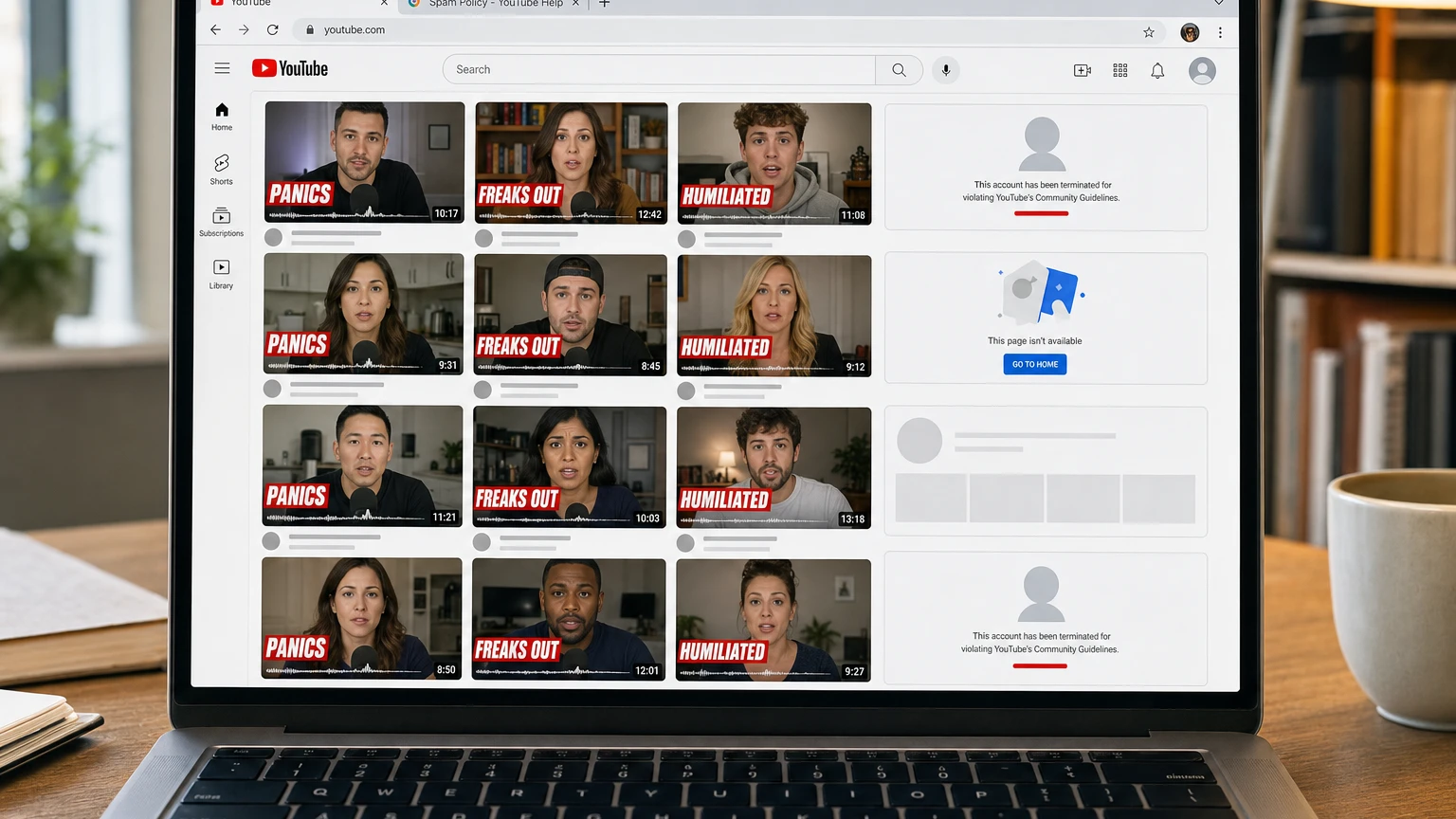
YouTube has terminated 20 channels tied to a network of paid on-camera presenters producing high-volume political videos with AI-assisted workflows. The company confirmed the action in reporting updated September 7, saying all 13 channels identified by investigators and seven related channels violated its spam policies.
The enforcement followed an investigation by Semafor and researchers Jeremy Carrasco and Mason Broxham of Riddance AI. They documented interconnected channels that appeared to be independent political commentators but shared presenters, production assets, websites, scripts and operational links.
The action matters because the videos were not conventional deepfakes. Real people appeared on camera, while AI was reportedly used behind the scenes for scripts, thumbnails, headshots and other production work. That combination made the channels look more like authentic creator-led commentary than a centrally managed content operation.
It also clarifies an important distinction in YouTube’s rules: the company did not say it removed the channels simply because they used AI or published partisan opinions. YouTube cited its spam policy, which covers coordinated networks, repetitive mass production, engagement manipulation and misleading clickbait.
What YouTube removed
YouTube said its review resulted in the termination of 20 channels: the 13 referenced in the investigation and seven additional channels it considered related. The platform has not released a public channel-by-channel enforcement report identifying the exact conduct attributed to each account.
By the time YouTube’s action became public, most of the channels examined by Semafor were unavailable. Some displayed notices saying they had violated YouTube’s rules, while others appeared to have been deleted or cleared by their operators.
| Key question | What has been confirmed |
|---|---|
| How many channels were terminated? | 20 channels: 13 named in the investigation and seven related accounts. |
| What policy did YouTube cite? | Spam policies, including the company’s broader rules against spam and deceptive practices. |
| Was AI use itself the stated violation? | No. YouTube did not describe the enforcement as a penalty for using AI tools. |
| How large was the investigated network? | Riddance AI said it had accumulated more than 45 million YouTube views and 90,000 comments by mid-August. |
| What remains unknown? | The complete list of terminated channels, the specific violation assigned to each one, their advertising revenue and whether any operators appealed. |
Why the operation drew a spam enforcement
YouTube’s current spam policy applies not only to individual videos but also to metadata, thumbnails, behavior and coordinated networks of channels. It specifically prohibits using automated tools or AI to produce high volumes of substantially similar content with minimal changes.
The policy also covers malicious clickbait: titles, descriptions, thumbnails or images that materially mislead viewers about what a video delivers. Channel termination is among the potential consequences for severe or repeated violations.
Investigators said the political channels displayed several of the signals described in that policy. They used closely matched formats, recurring narrative structures, shared music, overlapping script passages and titles that repeatedly paired a politician’s name with an emotional all-caps verb.
Riddance analyzed 622 transcripts from the network. Its researchers found hundreds of reused script segments, including 304 shared passages between two US-focused personas. The channels also reused the same ominous piano music and sometimes placed one presenter’s videos on another persona’s account without explanation.
The similarities extended beyond the videos. Websites and Linktree pages associated with the personas sometimes linked to the wrong commentator, while investigators said the related sites were taken offline at roughly the same time after Semafor contacted the company connected to the operation.
The channels used real actors instead of synthetic presenters
The central tactic was simple: preserve the scale of an AI content pipeline while placing a human face at the end of it.
People presented as recurring political commentators recorded direct-to-camera monologues in home or studio settings. Investigators said the channels gave those presenters persistent identities across YouTube, websites and other services, making them appear to be independent journalists, podcasters or political creators.
Semafor identified one presenter known as “Omar” as video creator Kareem M. Maize and another known as “William” as actor Frank George. Maize acknowledged that some location details attached to his personas were untrue. George confirmed that he was paid to record the material through a broker and identified that broker as Casgains.
Casting listings connected to the operation sought on-camera spokespeople who could deliver news-style scripts quickly using their own cameras, microphones and lighting. One listing offered $26 per completed video and described the work as a continuing, high-volume assignment.
This model filled a weakness in fully synthetic video production. AI could assist with writing, images, thumbnails, websites and editing, while a gig worker supplied natural speech and believable direct-to-camera delivery.
How the political videos gained an audience
The channels overwhelmingly focused on negative stories about Democratic officials, including New York Mayor Zohran Mamdani, California Gov. Gavin Newsom, Illinois Gov. JB Pritzker and Rep. Alexandria Ocasio-Cortez. Riddance found that Mamdani was the most frequently targeted person across the 622 transcripts it reviewed.
Recurring subjects included taxes, government budgets, real-estate problems and claims that businesses were fleeing Democratic-led cities or states. Investigators said many videos began with a real event or published report but escalated it through unsupported conclusions, exaggerated language or titles that did not match the actual commentary.
In one example, a William Reports News title claimed Mamdani was panicking over a purported Hilton hotel shutdown. Semafor found that the video did not establish that claim and effectively said the opposite. Another channel claimed New York Gov. Kathy Hochul had rejected a tax proposal backed by Mamdani even though Hochul had supported it.
The formula found a substantial audience. Riddance estimated that the network exceeded 45 million YouTube views and 90,000 comments by mid-August, before the enforcement action. The researchers said much of the commenting activity appeared consistent with real audiences on other US right-leaning channels, although they could not eliminate every possibility of inauthentic activity.
Analytics uncovered for several accounts suggested the audiences were heavily male and older, with roughly four in five viewers over 55. One exposed dashboard indicated that about 85% of an account’s viewers were in the United States.
Who investigators linked to the network
Semafor and Riddance traced the investigated operation to Caleb Chan, who developed the Casgains Academy financial YouTube channel before promoting Virelox as a business for rapidly launching and growing social-media accounts.
Chan had publicly promoted the “ghost creator” model as an inexpensive alternative to conventional advertising. In earlier posts, he described using AI and repeatable systems to create channels at scale and made sweeping claims about operating hundreds of accounts and creators. Those promotional figures have not been independently audited.
Before the enforcement, Chan told Semafor that Virelox Media was an independent digital publisher with more than 50 writers, editors, researchers and hosts. He denied producing the political material for campaigns, political action committees, ideological organizations or paid political sponsors. He also denied using deepfake anchors or automated spam bots.
After the investigation appeared, Chan described the coverage as a “hit piece” and said he had built a media studio involving 97 anchors, editors and scriptwriters. He portrayed the network’s output as ideologically motivated commentary rather than a purely commercial effort.
The available reporting has not established that a political campaign, party, PAC or foreign government paid for the channels. Riddance said it could not determine definitively whether the operation was built principally to collect advertising revenue or whether an undisclosed third party had commissioned any of the political content.
This was not simply a crackdown on AI scripts
YouTube’s decision should not be read as a ban on creators using AI for research, brainstorming, captions, scripts, editing assistance or thumbnails.
The company’s altered-content disclosure system focuses on realistic synthetic or meaningfully altered media that viewers could mistake for a real person, place or event. YouTube has explicitly said that using generative AI for production assistance, including generating scripts or content ideas, does not by itself require an altered-content label.
In May 2026, YouTube made labels for photorealistic AI content more visible and began introducing automatic detection signals. But a real presenter reading an AI-assisted script may not trigger that system because the person shown in the video is not synthetic.
That leaves other rules to address the surrounding behavior. In this case, YouTube used its spam policy, which can evaluate a network’s production volume, repetition, coordination and misleading presentation rather than asking only whether a face or voice was generated by AI.
The distinction is consequential for legitimate creators. A newsroom using an AI tool to organize research is not equivalent to an operator launching a collection of interchangeable personas with repetitive videos. The risk rises when automation is combined with coordinated publishing, false identities, recycled material and titles that promise claims the videos do not support.
What viewers and creators can take from the removals
For viewers
- A real face is not proof of an independent creator. Presenters can be actors hired to execute scripts for an operator they do not publicly identify.
- Check whether the channel explains who owns it. A biography, website and professional-looking set do not establish editorial independence.
- Compare the headline with the video’s actual evidence. Emotional titles may attribute reactions or decisions to public figures that the video never substantiates.
- Look for repeated production patterns. Identical music, phrasing, graphics and story structures across supposedly unrelated channels can indicate coordination.
- Verify political and economic claims with identifiable reporting. A long monologue can still be based on a distorted headline or nonexistent event.
For creators and publishers
- AI assistance is not a blanket violation. The relevant questions include how the tools are used and whether the resulting network misleads viewers or floods the platform with repetitive material.
- Disclosure rules and spam rules are separate. A video that does not require an altered-content label can still violate YouTube’s other policies.
- Human involvement does not neutralize automation risk. Hiring presenters to record scripts does not protect a coordinated mass-production system from enforcement.
- Titles and thumbnails remain part of the review. Creators should be able to support the central promise made before a viewer clicks.
- Clear ownership and attribution build resilience. Publishers using contracted hosts should accurately explain the presenter’s role and who controls the channel.
Those distinctions are becoming increasingly important as AI tools change YouTube production without eliminating the need for accountable editorial judgment.
What happens next
The immediate enforcement removed one documented group of channels, but it does not resolve the broader detection challenge. The workflow is inexpensive and reproducible: AI handles much of the production process, while a human presenter supplies the visible layer of authenticity.
The next test for YouTube is whether it can identify similar operations before they accumulate tens of millions of views or require outside investigators to map their shared infrastructure. That may involve looking beyond synthetic faces and voices toward behavioral signals such as repeated scripts, coordinated upload timing, shared assets and networks of interchangeable personas.
Questions also remain about appeals, possible replacement channels and whether clips from the terminated accounts continue circulating on TikTok or other platforms. Riddance had already identified a wider clipping ecosystem distributing excerpts from the YouTube videos.
For now, the clearest lesson from the 20-channel termination is that YouTube is willing to treat industrialized AI-assisted political publishing as spam when the surrounding operation crosses its platform-integrity rules. The visible host may be human, but the network behind that host still matters.
Make YouTube smarter with NextWatch AI
Use AI search, smarter discovery, playback tools and speed testing directly in your browser.
Add NextWatch AI to Chrome ↗