Nintendo will release Fire Emblem: Fortune’s Weave exclusively for Nintendo Switch 2 on Thursday, September 17, 2026. One day before launch, the most important news is not simply that another Fire Emblem campaign is arriving. Nintendo has now explained how its unusually flexible four-path structure, merged character progression and consolidated save system are intended to work.
The new details came in a three-part Ask the Developer interview published September 15 with director Toshiyuki Kusakihara, Intelligent Systems producer Masahiro Higuchi, Nintendo producer Genki Yokota and Nintendo associate producer Kenta Nakanishi. Their comments clarify that Fortune’s Weave is designed as an answer to a familiar problem with branching role-playing games: players should not have to commit dozens of hours to one route before seeing the others.
Players can begin with any of four heroes, move to another hero’s story partway through, progress through the paths in parallel or repeat a route with a different character build. The game eventually combines those experiences, including differently developed versions of the same recruit, into a stronger final force.
| Launch detail | Confirmed information |
|---|---|
| Release date | September 17, 2026 |
| Platform | Nintendo Switch 2 exclusive |
| Developer | Intelligent Systems |
| Digital price | $69.99 in the United States |
| Estimated download | 29.5 GB |
| Players | Single-player |
| Online feature | Save Data Cloud support |
| New control option | Joy-Con 2 mouse controls |
The four-path choice is not a permanent commitment
Fortune’s Weave centers on Cai, Dietrich, Theodora and Leda, four competitors entering the Heroic Games in the Dagdan Empire. Each has a personal objective, a largely distinct group of allies and a different way of interacting with the world.
Unlike Fire Emblem: Three Houses, however, selecting a hero does not lock the player into that perspective for the remainder of a lengthy campaign. Nintendo says there is no prescribed order for the paths and no irreversible route decision that players need to research before beginning.
The stories overlap around common events, allowing players to encounter another hero and jump to that character’s perspective if they want more context. A player could advance all four stories together, concentrate on one hero or move between them whenever a new character becomes more interesting.
Progress also reduces repetition. After reaching a certain stage, world-map destinations discovered in one path become available from the beginning of other paths. That should make subsequent exploration faster without eliminating the distinctive activities attached to each hero.
- Cai can catch and care for rideable animals, cultivate fields and trade what he harvests.
- Dietrich learns combat arts by defeating enemies and can continue strengthening those techniques.
- Theodora recruits soldiers in settlements and deploys them as battalions.
- Leda performs in taverns to earn rewards or uncover information about secret locations.
Even small decisions can persist. Animals named during Cai’s journey retain those names as the associated system becomes available elsewhere, reinforcing the idea that each path contributes something to the wider campaign.
Repeated playthroughs can make the same character stronger
The most consequential clarification concerns progression. If a player completes a route with the protagonist trained as a mage and later repeats it with a melee-focused build, the game does not simply discard one version. Nintendo says the character’s accumulated strengths will eventually be merged.
The same principle applies to recruits who appear in multiple routes. A unit developed one way in Cai’s party and another way under Dietrich can combine the results later. The final army is therefore shaped by the total collection of routes, builds and recruitment decisions made across the campaign.
This makes replaying a path part of the progression system rather than a clean restart. It also encourages experimentation with classes that might otherwise feel too risky in a strategy RPG where every level and stat increase matters.
Nintendo says Fortune’s Weave has one of the largest recruitable casts in the Fire Emblem series. Most heroes travel with members of their own clan, but additional fighters can be scouted in the capital, Dagsion. Certain members of another protagonist’s clan can also be recruited.
All of those systems support the game’s central idea: separate histories ultimately converge. The developers initially considered eight primary perspectives before narrowing the structure to four heroes, judging that eight would leave players with too much information and too many systems to manage.
The single-save design comes with chapter snapshots
The merged progression explains another potentially surprising decision: Fortune’s Weave consolidates the campaign into a single save file rather than asking players to maintain separate files for every route.
For players accustomed to preserving multiple Fire Emblem saves before important choices, that restriction may initially sound concerning. Intelligent Systems has paired it with a historical record of the campaign, preserving data from the beginning of every chapter for each main hero.
Players can jump back to those points to replay a chapter, revisit a map, watch a particular cutscene again or retry a battle. The developers also say the game does not contain permanently missable elements, reducing the pressure to reset immediately after overlooking an item or activity.
The intended rhythm is to continue forward after a setback, then use another path or repeat playthrough to recover what was missed. The Goddess of Fate’s time-traveling power provides the story explanation for this system, connecting retries and accumulated progression directly to the plot.
The practical trade-off is clear. Fortune’s Weave offers fewer conventional save slots, but it records structured return points and treats alternate outcomes as material that can contribute to the larger campaign. How intuitive that archive feels in a game of this scale will be one of the most important questions after launch.
Eshmel turns four separate stories into one campaign
The four competitors are not the only protagonists. Players also control Eshmel, a customizable savior sent into the past after the world falls under the rule of the demon god Balor.
The present-day crisis occurs five years after the Heroic Games, when the four heroes have disappeared. Assisted by the goddess Fortuna and acting on a mission from Sothis, Eshmel travels backward to intervene in their lives, recruit them and assemble the force needed for the final battle.
Eshmel was not part of the original story concept. The developers said the character was added after the initial four-hero structure had been planned, providing a central perspective comparable to the professor’s role in Three Houses. Time travel then became the device that allowed the separate journeys to feed one overarching objective.
That distinction matters because Fortune’s Weave is not four disconnected campaigns sold as one package. Nintendo is describing it as a single story that permits players to choose how and when they gather its component parts.
Fortune’s Weave shares a world with Three Houses, but changes the tone
Nintendo and Intelligent Systems also clarified the game’s relationship with Fire Emblem: Three Houses. Fortune’s Weave takes place in the same world and includes some returning characters, but the developers did not set out to make a straightforward sequel.
The new setting is Dagda, a land previously referenced from Fódlan. Where Three Houses drew heavily from medieval and Eastern European influences, Fortune’s Weave looks toward the ancient Mediterranean. Its nations exist in hotter environments, multiple gods openly coexist with humans, and its capital is built around the spectacle of the Heroic Games.
The contrast extends to the soundtrack. The developers commissioned flamenco guitar performances and emphasized hand claps and percussion to give Dagda a more forceful musical identity. Each of the four heroes also has an individual musical phrase, with those themes designed to combine when their stories meet.
Three Houses character designer Chinatsu Kurahana returned for Fortune’s Weave, helping preserve a visual connection between the two continents. Nintendo said Switch 2’s higher graphical detail created new demands for the character artwork, particularly across Dagda’s many climates, factions and elaborate costumes.
The production structure changed as well. Three Houses was built through a collaboration that included Koei Tecmo Games. For Fortune’s Weave, Nintendo says it established a new development arrangement with Intelligent Systems, drawing on lessons from the earlier project while pursuing a different style of game.
Combat remains tactical, but adds unusual classes and risks
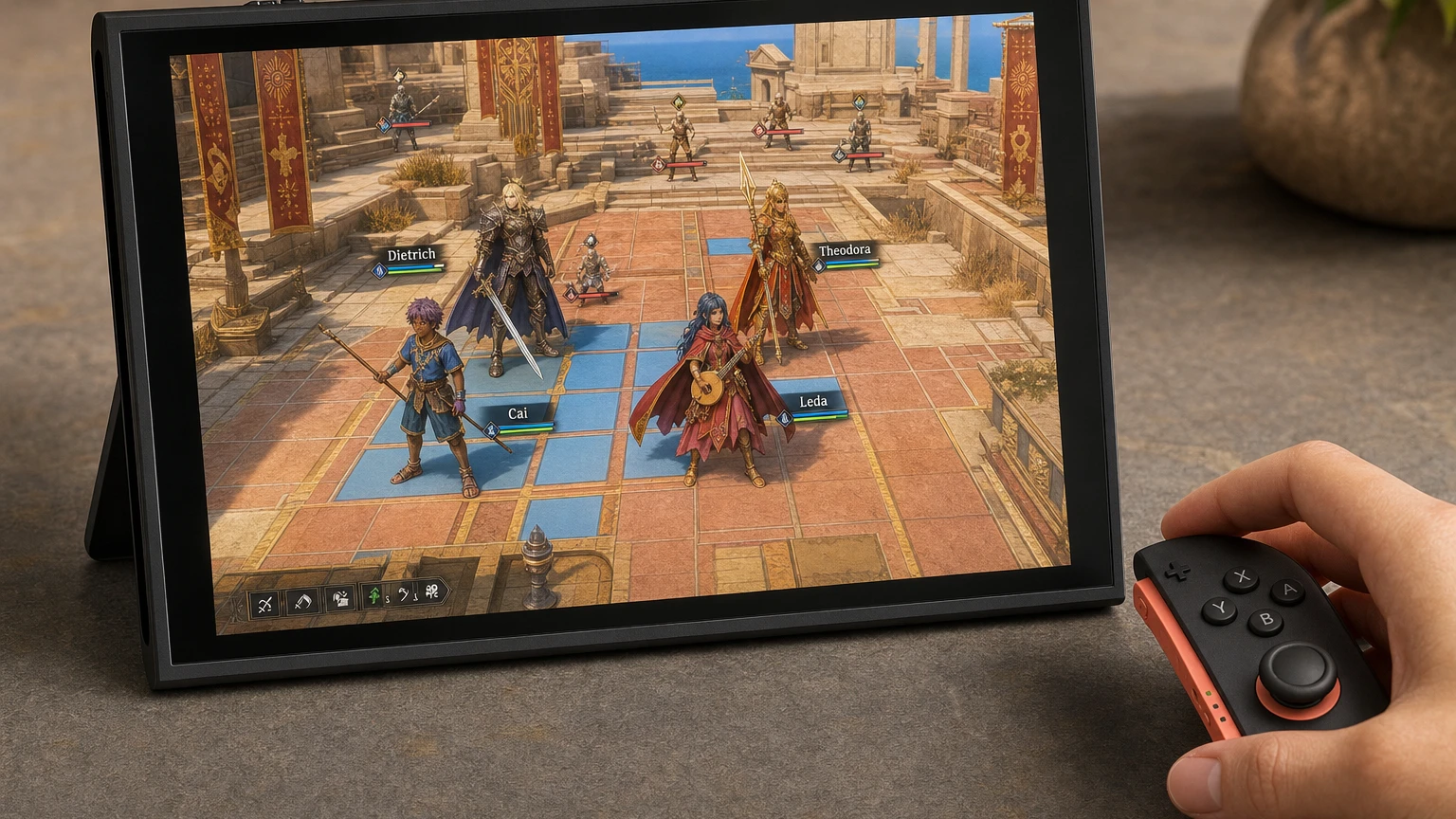
The foundation remains recognizable Fire Emblem: turn-based battles take place on gridded maps where weapon range, terrain, unit placement, classes and support between allies can determine the outcome.
Fortune’s Weave expands that framework with classes shaped by Dagda. These include ornius riders mounted on ostrich-like creatures, charioteers capable of striking enemies in a line and heavily armed elephant riders. One character carries a firearm-like weapon, an intentional mystery tied to the wider story.
The four heroes can also use Blaze Arts, powerful individual moves paid for with health rather than ordinary weapon durability. Activating them builds a shared Blaze Gauge. Reaching its midpoint grants a beneficial boost, but filling it completely triggers Burst, removes the bonus and cuts the hero’s maximum health in half. The system makes each spectacular attack part of a larger risk calculation.
Fortuna’s Blessing offers a safety net by allowing players to return to an earlier point after a move. Outside standard battles, dungeon encounters become turn-based Clashes in which allies can assemble attack combinations.
Switch 2 owners will also be able to operate the tactical interface with the Joy-Con 2 mouse feature. Nintendo presents this as an optional new control method rather than a replacement for conventional controls, but a pointer could be particularly useful when inspecting units and moving across large maps.
What buyers need to know before September 17
The digital edition costs $69.99 in the United States and requires an estimated 29.5 GB of storage. Nintendo also lists a $119.99 Dagdan Collection containing the game, a steel case, character art cards, a map of Dagda and an art book.
The game supports television, tabletop and handheld play, HDR output on compatible displays, Nintendo Account family-group lending and cloud saves. It is a single-player release and cannot be played on the original Nintendo Switch.
The final developer interview makes Nintendo’s pitch considerably clearer just before release. Fortune’s Weave is not merely repeating the house-selection model that helped make Three Houses successful. It is attempting to replace the anxiety of picking one exclusive route with a campaign where switching perspectives, repeating chapters and rebuilding characters are central mechanics.
What to watch after launch
The biggest unknown is whether Fortune’s Weave can make its enormous collection of routes, characters and progression systems feel manageable. Shared map discoveries and chapter snapshots should reduce repetition, but the merged-stat system and single-save structure will need to communicate exactly what is being preserved.
Players will also be looking for a definitive answer about when the game occurs relative to Three Houses. Nintendo has confirmed the shared world and returning figures without providing a simple label such as prequel or sequel.
If the interlocking systems work as described, Fortune’s Weave could offer something meaningfully different from both Three Houses and 2023’s Fire Emblem Engage: a tactical RPG in which alternate routes are not mutually exclusive stories, but strands of the same evolving playthrough.
Make YouTube smarter with NextWatch AI
Use AI search, smarter discovery, playback tools and speed testing directly in your browser.
Add NextWatch AI to Chrome ↗