
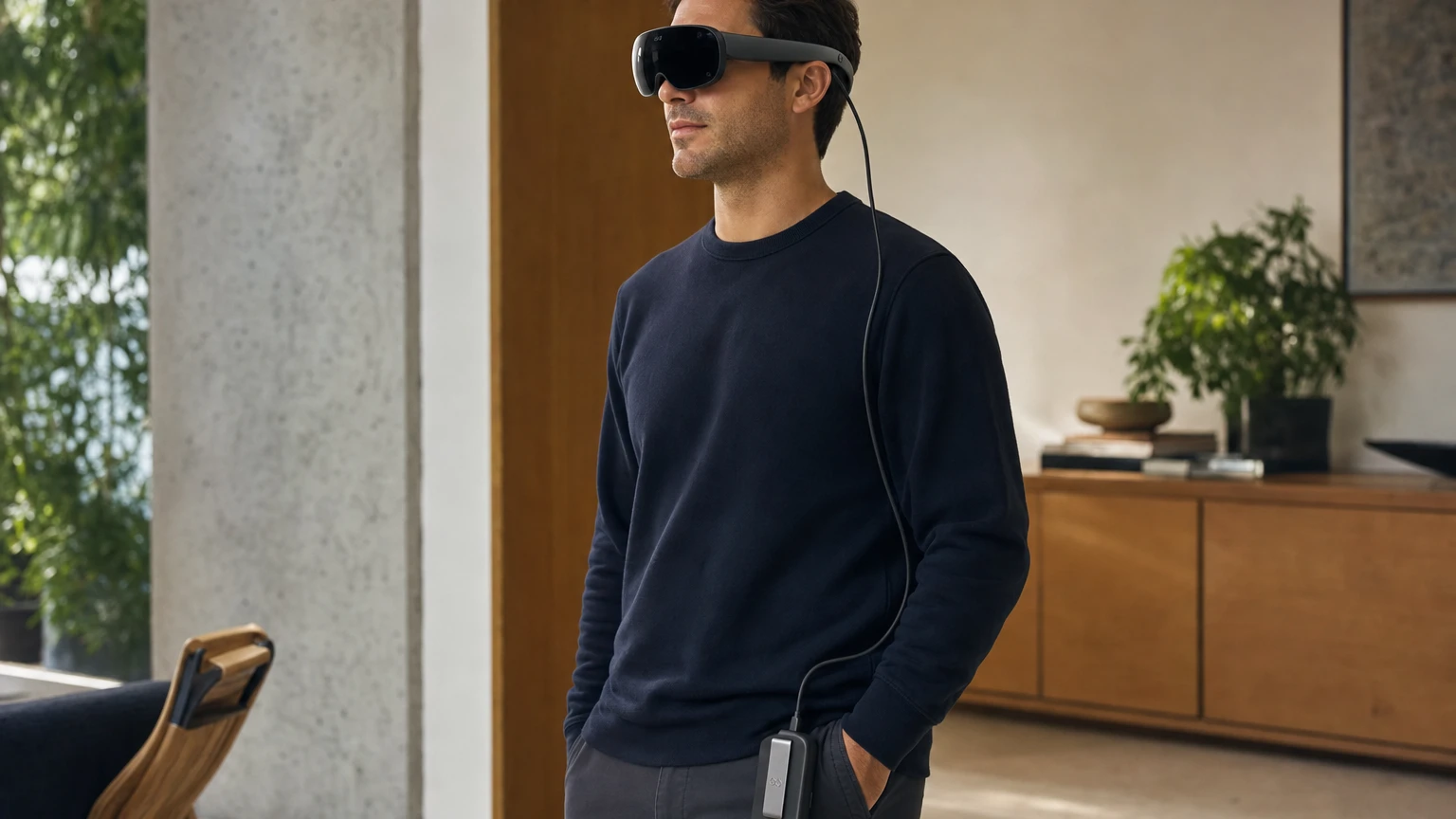
Meta has unveiled Meta VR Glasses, a new mixed-reality device that will cost $1,299.99 when it goes on sale in spring 2027. The company announced the product at Meta Connect on Wednesday, September 23, 2026.
The name suggests ordinary eyewear, but the product is better understood as a compact VR system. Its opaque micro-OLED displays sit inside a roughly 100-gram frame, while a separate 300-gram puck contains the processor, battery and storage. A thin optical cable permanently connects the two pieces during use.
Meta is pitching the device as a portable cinema, private workspace and game system rather than a direct replacement for Quest 3. The glasses put far less weight on the face and offer a sharper display, but their field of view is substantially narrower. The base package also does not include the Touch controllers that remain important for many conventional Quest games.
Meta has not announced a specific release date, preorder schedule or US pricing for optional accessories. Those omissions matter because the controllers, prescription inserts and light blockers could raise the cost of a complete setup beyond the advertised price.
Meta VR Glasses specifications
| Feature | Confirmed detail |
|---|---|
| US price | $1,299.99 |
| Release window | Spring 2027 |
| Glasses weight | About 100 grams |
| Compute puck weight | About 300 grams |
| Connection | Optical tether carrying power and data |
| Displays | Dual HDR micro-OLED panels |
| Resolution | 2,412 by 2,288 pixels per eye; 37 pixels per degree |
| Refresh rate | Up to 120Hz |
| Field of view | 70 degrees horizontal by 66 degrees vertical |
| Processor | Qualcomm Snapdragon Reality Elite |
| Memory | 12GB |
| Storage | 128GB, expandable by microSD card up to 1TB |
| Primary input | Eye tracking, hand gestures and voice |
| Controllers | Touch Plus supported but not included in the base package |
| Battery claim | Up to three hours of high-resolution media playback |
| Software platform | Meta Horizon OS and the Horizon Store |
The compute puck is the key to the lighter frame
Standalone headsets such as Quest 3 place their displays, processor, battery, storage, cameras and cooling hardware on the user’s head. Meta VR Glasses divide those components between the frame and a puck that can be clipped to a pocket or bag.
The glasses retain the displays and tracking sensors. The puck handles computing, power and storage, relying on Qualcomm’s Snapdragon Reality Elite processor. It connects to the frame through a flexible optical tether that supplies both power and data.
The complete system therefore weighs about 400 grams, based on Meta’s approximate figures. Its ergonomic advantage is not a dramatic reduction in total carried weight, but a redistribution of that weight: roughly one-quarter rests on the face, while the heavier component sits elsewhere.
That design removes the head strap and much of the front-heavy bulk associated with conventional VR headsets, but it introduces different compromises. The cable must remain connected, the actively cooled puck needs somewhere secure to sit, and users cannot walk away from it as they can with a fully self-contained Quest.
Independent hands-on testing was encouraging but too brief to settle the comfort question. A Road to VR reporter found the larger frame comfortable during a roughly 30-minute demonstration, while the smaller size clamped too tightly and slipped on the nose. Meta plans to sell separate Standard and Large versions with interchangeable nose pads, making fit an important issue to check before purchase.
A sharper display comes with a narrower view
The display system is the clearest technical upgrade over Quest 3. Meta’s “5K Infinite Display” uses two micro-OLED panels, each with a resolution of 2,412 by 2,288 pixels. Pixel density reaches 37 pixels per degree, compared with about 25 pixels per degree on Quest 3.
Higher pixel density should improve the legibility of text, films and virtual computer displays. Meta is also adding Dolby Vision HDR support and integrating Dolby Atmos spatial audio speakers into the frame.
The major compromise is field of view. Meta lists a 70-degree horizontal and 66-degree vertical view, compared with roughly 110 by 96 degrees for Quest 3. That means Meta VR Glasses cover a much smaller portion of the wearer’s vision, despite producing a denser image within that area.
This distinction is particularly important for gaming. A wide field of view helps a virtual environment feel as though it surrounds the player. A narrower display can feel more like a screen suspended in front of the user, even when the underlying image is exceptionally clear.
The frame has open sides, allowing users to retain natural peripheral awareness while seeing the area ahead through color passthrough cameras. Optional light blockers can create a more enclosed experience, but they cannot expand the display’s field of view.
These are also not transparent augmented-reality glasses like Meta’s experimental Orion prototype. The displays are opaque, and the wearer sees the physical environment ahead through cameras. If the device is switched off, users cannot simply look through clear lenses.
How Meta VR Glasses differ from Quest 3
| Category | Meta VR Glasses | Meta Quest 3 |
|---|---|---|
| Design | Glasses connected to a compute puck | Wireless all-in-one headset |
| On-face weight | About 100 grams | About five times the glasses’ on-face weight, according to Meta |
| Display technology | Micro-OLED | LCD |
| Pixel density | 37 pixels per degree | About 25 pixels per degree |
| Field of view | 70 by 66 degrees | About 110 by 96 degrees |
| Default input | Eyes, hands and voice | Touch controllers and hand tracking |
| Controllers included | No | Yes |
| Likely strength | Portable media, text clarity and private virtual screens | Untethered, controller-based and room-scale VR |
The two devices use the same Horizon software platform and store, but shared software does not make their experiences identical. Meta’s own developer guidance warns that the products differ in form factor and input, so one application build may not suit both devices without targeted changes.
Meta VR Glasses support the Touch Plus controllers used by Quest 3 and Quest 3S. Existing owners can pair those controllers, while new customers will be able to buy them separately. Meta also plans to offer a controller bundle through some retail channels, although it has not disclosed the bundle’s price.
With controllers connected, the glasses can run conventional Horizon Store content. Without them, buyers will depend on applications designed for eye and hand input. Meta says more than 75 games and apps will support controller-free interaction at launch, including a hand-tracked mode for Beat Saber.
The default interface combines gaze selection with hand gestures. Users look at an interface element and pinch to select it, while downward-facing sensors can track gestures with the hands resting near the lap. Voice commands and the operating system’s Meta AI assistant provide another way to open content and manage a workspace.
Meta is emphasizing movies and virtual work
The narrower view and controller-free base package help explain why Meta’s presentation focused heavily on media and productivity rather than traditional room-scale VR.
Meta says the glasses will be the first VR product certified for IMAX Enhanced viewing. The company is also preparing Dolby Vision video, 3D films and immersive environments through services and partners including Disney+, Prime Video, YouTube, Peacock, HBO Max and Paramount+.
For sports, Meta says it expects to offer more than 100 immersive live US events per year after the glasses launch, working with partners including ESPN, MLB, NBC Sports, TNT Sports and UFC. That is a future content commitment rather than a guarantee that every service or event will be available in every region.
Productivity is the other major use case. Users can arrange multiple private virtual displays while color passthrough keeps their desk, phone and surroundings visible. Meta also says its software can turn a flat surface into a tracked keyboard and touchpad, with conventional Bluetooth peripherals supported as an alternative.
The puck accepts DisplayPort video through USB-C, allowing compatible laptops, phones and gaming handhelds to feed a virtual screen directly to the glasses without a separate capture card. That could make the device appealing to travelers who value a large private display more than a wide, fully immersive VR view.
Meta’s battery estimate is up to three hours for continuous high-resolution media playback, with 45-watt fast charging and charging during use. The company has not provided equivalent figures for demanding mixed-reality games, virtual work or other workloads, so the media estimate should not be treated as universal battery life.
What buyers should wait to learn
The announcement establishes the product’s central trade: Meta has moved most of the weight off the face, but it has done so by adding a separate puck, a permanent tether and a narrower field of view.
Media viewers, frequent travelers and people who find conventional headsets uncomfortably heavy may see value in that exchange. Buyers focused on untethered room-scale gaming may be better served by Quest hardware, particularly because Quest includes controllers and provides a substantially wider view.
Several practical details remain unresolved. Meta still needs to announce the exact release date, preorder timing, regional availability, final box contents and accessory prices. Prospective buyers should also wait for independent tests of long-session comfort, battery life across different workloads, puck heat, cable durability, audio leakage and software compatibility.
At $1,299.99 before optional accessories, Meta VR Glasses are aimed at early adopters and buyers with a specific need for a compact private display. Their 100-gram frame is a meaningful engineering change, but whether moving the bulk into a pocket makes VR substantially easier to live with will only become clear when finished retail hardware arrives in spring 2027.
Make YouTube smarter with NextWatch AI
Use AI search, smarter discovery, playback tools and speed testing directly in your browser.
Add NextWatch AI to Chrome ↗