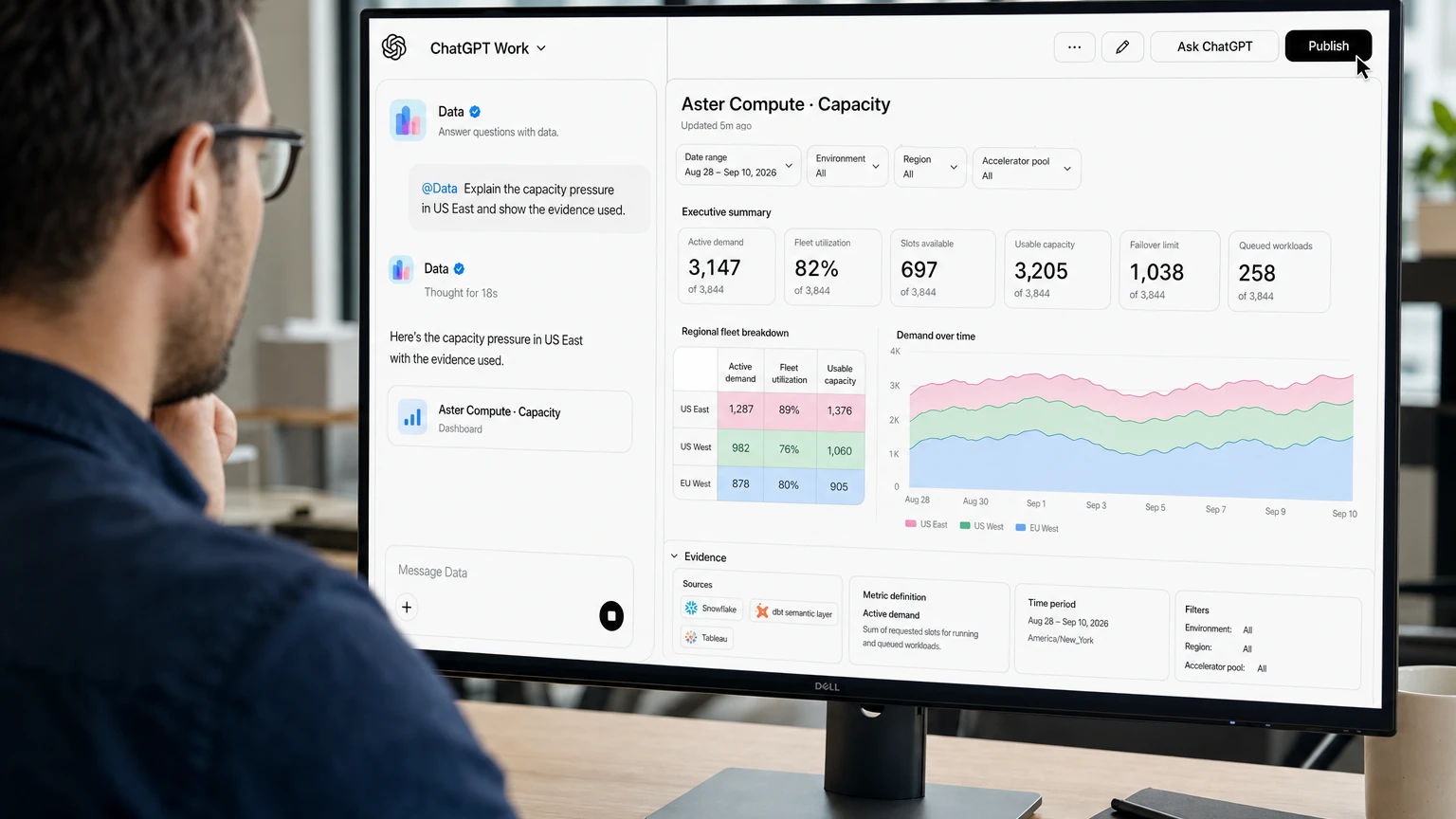
OpenAI launched a Data agent in ChatGPT Work on September 10, giving employees a conversational way to investigate governed company data, generate interactive dashboards and carry findings into approved business actions.
The product connects ChatGPT Work to data warehouses, operational platforms, company documents, semantic layers and established business intelligence tools. A user can ask why sales declined, which accounts present renewal risks or where spending changed, then refine the analysis through follow-up questions rather than writing SQL or waiting for a new report.
The launch moves ChatGPT Work into a consequential enterprise category already contested by data-platform vendors, BI companies and AI assistants. OpenAI’s differentiator is breadth: the agent is intended to coordinate context across systems a company already uses instead of requiring the organization to migrate its data into a new analytics stack.
But the release comes with an important gap. OpenAI has not published an external accuracy or retrieval benchmark for the Data agent, leaving prospective customers to validate its performance against their own reports, definitions and production workloads.
What OpenAI’s Data agent can do
| Capability | What it means for users |
|---|---|
| Conversational analysis | Employees can ask business questions in plain language and continue investigating the results in the same conversation. |
| Connected company data | The agent can work with approved warehouses, analytics platforms, operational sources, files and documents. |
| Business context | It can use established metric definitions, custom calculations, dataset relationships and semantic layers. |
| Interactive dashboards | Analyses can become editable, shareable and refreshable dashboards with charts, filters and supporting explanations. |
| Existing BI tools | The agent can build or interact with dashboards in supported platforms such as Power BI, Tableau and Sigma. |
| Approved follow-up actions | Depending on connected tools and permissions, users can prepare communications, share findings or complete authorized actions. |
The agent appears in ChatGPT Work’s plugin directory under the name Data. Administrators can make it available to selected users or install it for a team, while individual workers can begin an analysis by addressing @Data. OpenAI says the plugin can also be invoked automatically when ChatGPT determines that a request requires it.
Installation alone does not create access to company systems. The relevant source plugins or connected applications must also be enabled, configured and authorized. Availability can vary by plan, workspace, role, region and the capabilities supported by each provider.
Which data sources and dashboards are supported?
OpenAI named a broad initial group of supported systems, spanning structured databases, observability data, company files and BI products.
| Category | Named integrations |
|---|---|
| Data warehouses and platforms | Amazon Redshift, ClickHouse, Databricks, Google BigQuery, MongoDB and Snowflake |
| Operational and observability data | Datadog and other approved connected sources |
| Files and documents | Google Drive and Microsoft SharePoint |
| Business context | Databricks Genie Ontology, dbt, GitHub, Snowflake Horizon, semantic layers and trusted dashboards |
| BI and visualization tools | Omni, Oracle BI, Microsoft Power BI, Sigma, Tableau and ThoughtSpot |
That mix matters because a business question rarely lives inside one database table. A decline in customer retention, for example, may require product usage data, an approved definition of an active customer, support documents and an existing executive dashboard. The Data agent is designed to gather that context during the workflow and return findings to the appropriate destination.
OpenAI is not presenting the agent as a replacement for Snowflake, Databricks, Tableau or Power BI. Several of those companies are launch partners. ChatGPT Work instead becomes a natural-language coordination layer that can draw from their data, semantics and visualization capabilities.
Governance inherits existing permissions—but that is not the entire security test
OpenAI says queries enforce the permissions of the connected account, including applicable restrictions at the table, row and column level. Workspace administrators decide which connections are available and, where role-based controls are supported, which groups can use them.
The governance model has several distinct layers:
- Plugin access: An administrator determines whether the Data plugin is available or preinstalled.
- Source access: Each underlying app, warehouse or BI platform must be enabled and properly configured.
- User authorization: The connected identity must already have permission to view the requested records.
- Action controls: Read and write operations can have separate settings, confirmation requirements and provider restrictions.
- Artifact sharing: Dashboards and reports create an additional distribution boundary that teams must review.
The final point is especially important. OpenAI’s documentation says data used in an analysis is copied into a published ChatGPT Site when a user publishes the resulting dashboard or report. Organizations therefore need to check the artifact’s audience rather than assuming that the source system’s row-level permissions automatically follow every generated output.
Actions also depend on the connected tool. Sending findings through Slack or email, updating another system or initiating a workflow may require user approval and sufficient provider-side permissions. Administrators can allow reading while preserving stricter confirmation rules for changes.
For Business, Enterprise and Edu workspaces, OpenAI says customer inputs and outputs are not used to train its models by default. Companies still need to assess the privacy, retention and residency terms of any third-party service receiving information during a connected workflow.
Why semantic layers may matter more than the chat interface
A fluent answer is not necessarily a correct business answer. Two departments may define revenue, churn, active users or qualified pipeline differently, even when they query the same warehouse.
The Data agent attempts to address that problem by using a company’s existing semantic layer: the governed definitions, calculations and relationships that explain what the underlying fields mean. OpenAI strongly recommends pairing the plugin with a data warehouse, an authoritative semantic layer and, where useful, an existing BI tool.
This approach could reduce one of the biggest risks in natural-language analytics: generating a technically valid query based on the wrong definition. It does not eliminate that risk. OpenAI’s own guidance tells users to verify the source, time period, filters and metric definition before relying on a result, particularly when the answer conflicts with an established report.
For data teams, that changes the likely division of labor rather than eliminating specialist work. Analysts may receive fewer routine requests for one-off charts, but organizations will need stronger ownership of metric definitions, source quality, access rules, audit records and reusable analysis templates.
The product grew out of OpenAI’s internal data agent
OpenAI described an internal-only predecessor in January 2026. At the time, the company said its data platform served more than 3,500 internal users and covered over 600 petabytes across approximately 70,000 datasets.
At that scale, locating the correct table could take longer than the analysis itself. OpenAI’s internal system combined table-usage patterns, human annotations, code-based enrichment, institutional knowledge, memory and runtime context to help employees move from a question to an answer.
Arpan Shah, OpenAI’s general manager for its enterprise technology vertical, told VentureBeat that the commercial Data agent was a generalized version of that internal approach. Rather than copying OpenAI’s company-specific data architecture, the released product is designed to work across customers’ existing warehouses, BI systems and connected applications.
OpenAI also named 11 organizations that participated in its alpha program, including NTT Data, Thermo Fisher Scientific, ServiceTitan, Zipline, Empower, Piston, CookUnity, Turing and micro1.
The examples are promising but should be treated as customer-reported launch evidence, not controlled performance testing. ServiceTitan said it used the agent to identify that users of its Atlas AI sidekick launched campaigns at roughly three times the rate of nonusers. NTT Data said non-engineers were able to create and update dashboards in plain language. Micro1 reported rebuilding performance-tracking dashboards in about half an hour while finding errors in the originals.
The missing benchmark is a material unanswered question
OpenAI did not publish a standardized measure of retrieval accuracy, analytical correctness, dashboard reliability or completion time for the external Data agent.
Shah told VentureBeat that OpenAI uses an internal comparison against its own data tools, but the company did not disclose a score. That makes it difficult to compare the agent with specialized data products that publish evaluation methods or performance claims.
There is also no persistent, newly created context layer spanning all of a customer’s systems. OpenAI’s described approach brings existing context together when it is needed, rather than constructing a separate universal model of the company’s data.
That design has potential advantages: customers can retain the tools and governed definitions they already trust. It also makes output quality dependent on the condition of those systems. Missing documentation, conflicting metrics, stale dashboards and overly broad permissions will not be repaired simply by placing a conversational interface above them.
What the launch changes for business and data teams
Routine analysis could move closer to the decision-maker
Sales, marketing, finance, operations and product teams can potentially investigate common questions without placing every request in an analyst queue. The practical gain is not merely faster chart creation; it is the ability to ask follow-up questions immediately while the business context remains fresh.
Data teams become the maintainers of reliable self-service
Organizations will still need specialists to manage pipelines, schemas, definitions, data quality and permissions. The work may shift from repeatedly producing similar reports toward building the governed foundation that allows an agent to produce dependable answers.
BI tools gain another interface rather than disappearing
OpenAI’s partnerships indicate that dashboards remain important destinations. ChatGPT Work can make them easier to create and interrogate, while established BI products continue to provide governed models, visualization systems and operational infrastructure.
Generated actions raise the stakes
An incorrect chart is a problem; an incorrect finding automatically distributed to executives or used to update another system can be a larger one. Companies should introduce write capabilities only after read-only analyses are reproducible and approval policies are tested.
How companies should evaluate the Data agent
A useful pilot should measure more than whether employees like the conversational interface. Teams can begin with a restricted workspace, a small set of representative questions and known-good reports for comparison.
- Test permission precision. Confirm that users cannot retrieve records, fields or documents outside their existing access.
- Measure metric fidelity. Compare answers with approved definitions for revenue, retention, pipeline and other core measures.
- Inspect evidence. Review which sources, filters, time ranges and transformations support each conclusion.
- Track correction time. A fast first answer offers limited value if analysts spend longer finding and repairing hidden errors.
- Review publishing behavior. Test who can open generated dashboards and what happens when access to a source changes.
- Add actions gradually. Begin with read-only workflows, then introduce reversible, low-risk actions with explicit approval.
- Calculate total cost. Include ChatGPT usage, source-platform compute, connector requirements and human review—not just product licensing.
What to watch next
The first major test will be whether OpenAI publishes a transparent external benchmark or evaluation framework for the Data agent. Enterprise buyers will want evidence covering analytical correctness, permission enforcement, source attribution and performance on ambiguous real-world questions.
More detailed availability and pricing information will also matter. OpenAI has not provided a universal plan-by-plan price, service guarantee or definitive matrix showing every supported action across every connector.
Finally, companies will be watching whether the product succeeds outside controlled pilots. The agent’s long-term value depends on its ability to work with inconsistent definitions, incomplete documentation and complex permission structures—the ordinary conditions of enterprise data, not just polished demonstrations.
OpenAI has made the interface for company analytics dramatically simpler: ask a question, inspect the evidence, build a dashboard and act on the result. The harder problem is proving that the answer remains trustworthy when the underlying business decision matters. That is now the standard the Data agent will have to meet.
Make YouTube smarter with NextWatch AI
Use AI search, smarter discovery, playback tools and speed testing directly in your browser.
Add NextWatch AI to Chrome ↗