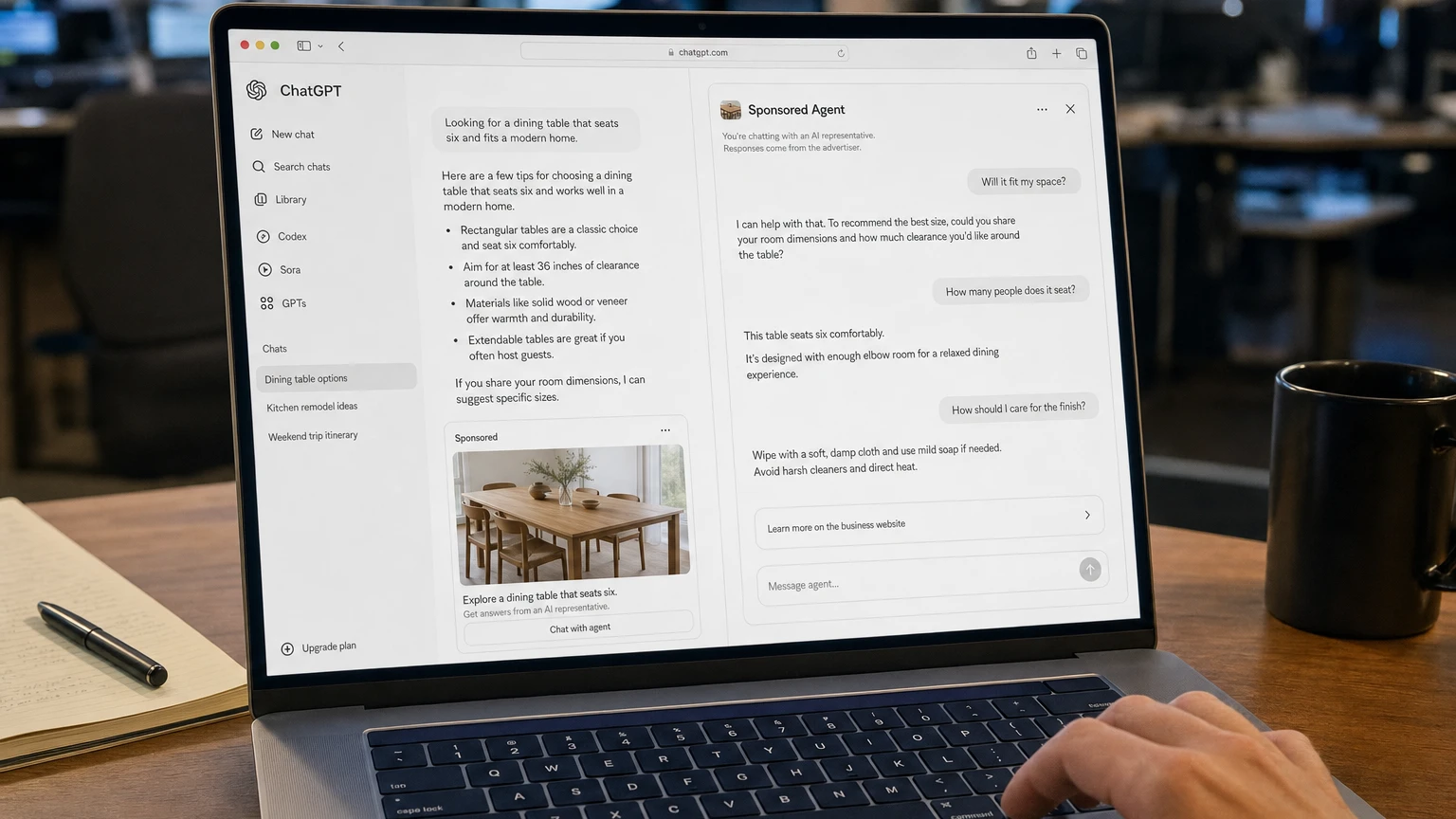
OpenAI began testing Sponsored Agents with select U.S. advertisers on September 16, 2026, introducing a ChatGPT ad format that lets users voluntarily open a conversation with an AI representative of the business behind an ad. The important boundary is that the resulting brand chat is clearly labeled and separate from both ChatGPT’s independent answer and the conversation that originally produced the ad.
This is not a general release for every advertiser, and businesses cannot simply activate the format in Ads Manager. OpenAI describes Sponsored Agents as a limited alpha test, with no public timetable for wider access. But the experiment represents a consequential change in how advertising can work inside an AI assistant: the paid experience no longer has to end with a promotional card and a link.
Instead, an advertiser may be able to answer product questions, qualify a prospective customer and guide that person toward a purchase while the user remains inside ChatGPT. That makes the separation between an independent assistant and a seller’s representative particularly important for users to understand.
How a Sponsored Agent works in ChatGPT
Sponsored Agents begin with an ordinary ChatGPT ad rather than appearing unprompted as part of the assistant’s answer. OpenAI describes the current flow as follows:
- ChatGPT provides its normal response to the user.
- A relevant, clearly identified sponsored placement may appear below that response.
- The user can choose to open a conversation with the advertiser’s Sponsored Agent.
- A separate, labeled brand conversation begins inside ChatGPT.
- The user can ask follow-up questions and, when ready, follow a link to the advertiser’s website.
OpenAI illustrates the format with someone considering a dining table. Rather than immediately visiting the seller’s site, the shopper could ask whether the table fits a particular space, how many people it seats or how its finish should be maintained.
The Sponsored Agent is different from ChatGPT’s existing Ask ChatGPT ad feature. Ask ChatGPT lets a user share an ad with the regular assistant and request an independent explanation. Advertisers do not control those answers. A Sponsored Agent, by contrast, is explicitly acting as an AI representative of the advertiser.
| Experience | Who it represents | Relationship to the original chat |
|---|---|---|
| Normal ChatGPT answer | ChatGPT’s independent assistant | Part of the user’s original conversation |
| Ask ChatGPT about an ad | ChatGPT’s independent assistant | The user brings the ad into a regular assistant conversation |
| Sponsored Agent | The business paying for the advertising experience | A separate, clearly labeled conversation opened by the user |
What remains private—and what the advertiser can see
OpenAI says advertisers cannot access a user’s private ChatGPT conversations, chat history, memories, name, email address, precise location, IP address or sensitive information. The company also says advertising does not influence, rank or modify ChatGPT’s independent responses.
However, the privacy boundary changes when a user deliberately starts communicating with a business through an ad. In that case, the advertiser can see the messages the user sends directly to it. For Sponsored Agents, readers should therefore treat the new conversation as communication with the advertised business, not as a continuation of a private exchange with the ordinary ChatGPT assistant.
ChatGPT can use information internally to determine which ads may be relevant. Depending on the user’s settings, those signals can include the current discussion and, when personalized advertising is enabled, selected information from past chats, memory and earlier ad interactions. OpenAI says those signals stay within ChatGPT rather than being handed to advertisers.
The broader ChatGPT ad program is limited by account type. OpenAI says ads are not shown on Plus, Pro, Business, Enterprise or Edu accounts, or on accounts identified as belonging to users under 18. Sponsored Agents will consequently be encountered through the ad-supported side of ChatGPT, although OpenAI has not disclosed how many users will see the format during the alpha or precisely where the user-facing test is running.
Which advertisers can access Sponsored Agents
Sponsored Agents are not available to the general advertiser market. OpenAI’s Help Center says the format is restricted to selected advertisers in a limited alpha and that the company is not accepting general early-access requests.
A narrower registration page associated with HubSpot is collecting expressions of interest for possible future testing. That page warns that access is limited, subject to review and not guaranteed. It also says possible eligibility requirements may include the use of automated creative tools, automatic bidding and a minimum daily advertising spend maintained for 28 days, with the final threshold to be confirmed before onboarding.
That leaves most advertisers with access only to OpenAI’s established ChatGPT ad formats and newly expanded campaign tools. A company can create a standard ChatGPT Ads account without automatically becoming eligible to operate a Sponsored Agent.
Advertisers carry responsibility for what the agent says
OpenAI’s advertising terms place a significant compliance burden on participating businesses. Even when OpenAI creates, configures or makes the Sponsored Agent available, the advertiser is treated as its builder and remains responsible for its content, configuration, connected Actions, output and supporting advertising materials.
That means reviewing a Sponsored Agent is potentially more complex than approving an image, headline and landing page. Businesses will need to test the answers produced across a range of realistic—and difficult—customer questions.
- Prices and promotions: Can the agent distinguish a current offer from an expired one?
- Inventory: Does it admit when it lacks reliable stock or availability information?
- Product specifications: Can it avoid inventing dimensions, compatibility details or performance claims?
- Delivery promises: Will it refuse to guarantee an arrival date it cannot verify?
- Returns and warranties: Are its answers consistent with the business’s actual policies?
- Connected Actions: If the agent can perform a task, what confirmation and recovery steps protect the user?
OpenAI’s terms contemplate Sponsored Agents with Actions, but the launch announcement does not explain which actions are enabled in the current test, whether they can complete transactions or lead submissions, or when explicit user confirmation is required. Those details will determine whether the format functions primarily as a conversational product guide or evolves into a transaction-capable sales agent.
OpenAI is also automating the advertiser’s side of the platform
Sponsored Agents are the most visible consumer-facing change, but OpenAI announced them as part of a broader expansion of ChatGPT Ads. The company is applying generative AI to campaign creation, creative production, optimization and reporting.
- Natural-language campaign management: An Ads Manager plugin in ChatGPT Work can turn a website or marketing brief into a campaign, modify settings, analyze results and suggest next steps.
- AI-assisted creative: Ads Manager can recommend images and copy based on a campaign’s objective and landing page. Advertisers can review and edit the suggestions before using them.
- Contextual text customization: Advertisers can opt into a system that adapts existing headlines and descriptions to the context of a conversation and translates them into the user’s preferred language.
- HubSpot integration: Businesses can connect a ChatGPT Ads account, create campaigns, monitor performance and follow up on leads through HubSpot.
- Shopify integration: U.S.-based Shopify merchants can use a ChatGPT Ads app that connects their product catalog and measurement tools. OpenAI says the app is scheduled to reach other eligible ChatGPT Ads markets on September 23, 2026.
The rollout complements OpenAI’s wider effort to make agents usable by companies and developers. That effort also includes OpenAI’s Agents API and specialized workplace products such as its Data Agent in ChatGPT Work.
What OpenAI has not disclosed about the alpha
The initial announcement explains the basic user experience but leaves several commercial and safety questions unanswered.
| Question | What is currently known |
|---|---|
| Which companies are testing it? | OpenAI says only that selected U.S. advertisers are participating. |
| How much does it cost? | No Sponsored Agent-specific pricing or buying model has been announced. |
| How is performance measured? | Standard Ads Manager reporting covers metrics such as impressions, clicks, spend and conversions, but OpenAI has not detailed agent-specific metrics. |
| How much data reaches the business? | Advertisers can see messages sent directly to them, but OpenAI has not published a complete Sponsored Agent data schema. |
| What can agents do? | The terms account for Actions, but enabled capabilities and confirmation requirements in the alpha remain unspecified. |
| When will access expand? | No wider release date has been provided, and general early-access requests are closed. |
Measurement will be particularly important. Chat starts alone would not show whether the format produces additional sales, stronger leads or merely another step between a motivated customer and checkout. Advertisers will want to know how many people open a Sponsored Agent, engage meaningfully, visit the business’s site and ultimately complete a desired action.
Why Sponsored Agents could reshape the advertising funnel
Most digital ads are designed to move a person from a platform to an advertiser-controlled destination as quickly as possible. Sponsored Agents test a different model: keep the prospective customer on the platform longer, answer objections there and send the person to the business only when the next step is clear.
That could produce fewer website visits but more informed visitors. A shopper who already confirmed sizing, compatibility and care requirements may be more prepared to buy. The opposite outcome is also possible: someone ready to purchase could find the extra conversation unnecessary and abandon the process.
The format also creates a new optimization surface for advertising teams. Performance may depend not only on the placement, copy and image but on the quality of every answer generated after the click. Agencies and brands may need to evaluate conversational accuracy, refusal behavior, tone, knowledge freshness and escalation paths alongside conventional campaign metrics.
For users, the central issue is whether the product preserves a visible and understandable boundary between advice from ChatGPT and persuasion from a paying business. A label at the start of the exchange is important; persistent identification, clear data notices and reliable controls may become even more important as the conversation grows longer or gains the ability to act.
What to watch next
- Whether OpenAI names the first participating advertisers or publishes alpha results.
- Whether Sponsored Agents receive their own billing and optimization model.
- Which conversation, lead and conversion metrics appear in Ads Manager.
- How long sponsored chats and messages are retained by OpenAI and advertisers.
- Whether the sponsored label remains continuously visible throughout an exchange.
- What Actions agents can perform and which steps always require user confirmation.
- Whether access expands beyond selected U.S. advertisers and the HubSpot-linked test.
Sponsored Agents remain a controlled experiment rather than a broad launch. Even so, the test moves ChatGPT advertising beyond placing a sponsored message beside an answer. OpenAI is now examining whether the advertisement itself can become an AI sales conversation—and whether it can do so without blurring the line between the assistant users trust and the business paying to speak with them.
Make YouTube smarter with NextWatch AI
Use AI search, smarter discovery, playback tools and speed testing directly in your browser.
Add NextWatch AI to Chrome ↗