
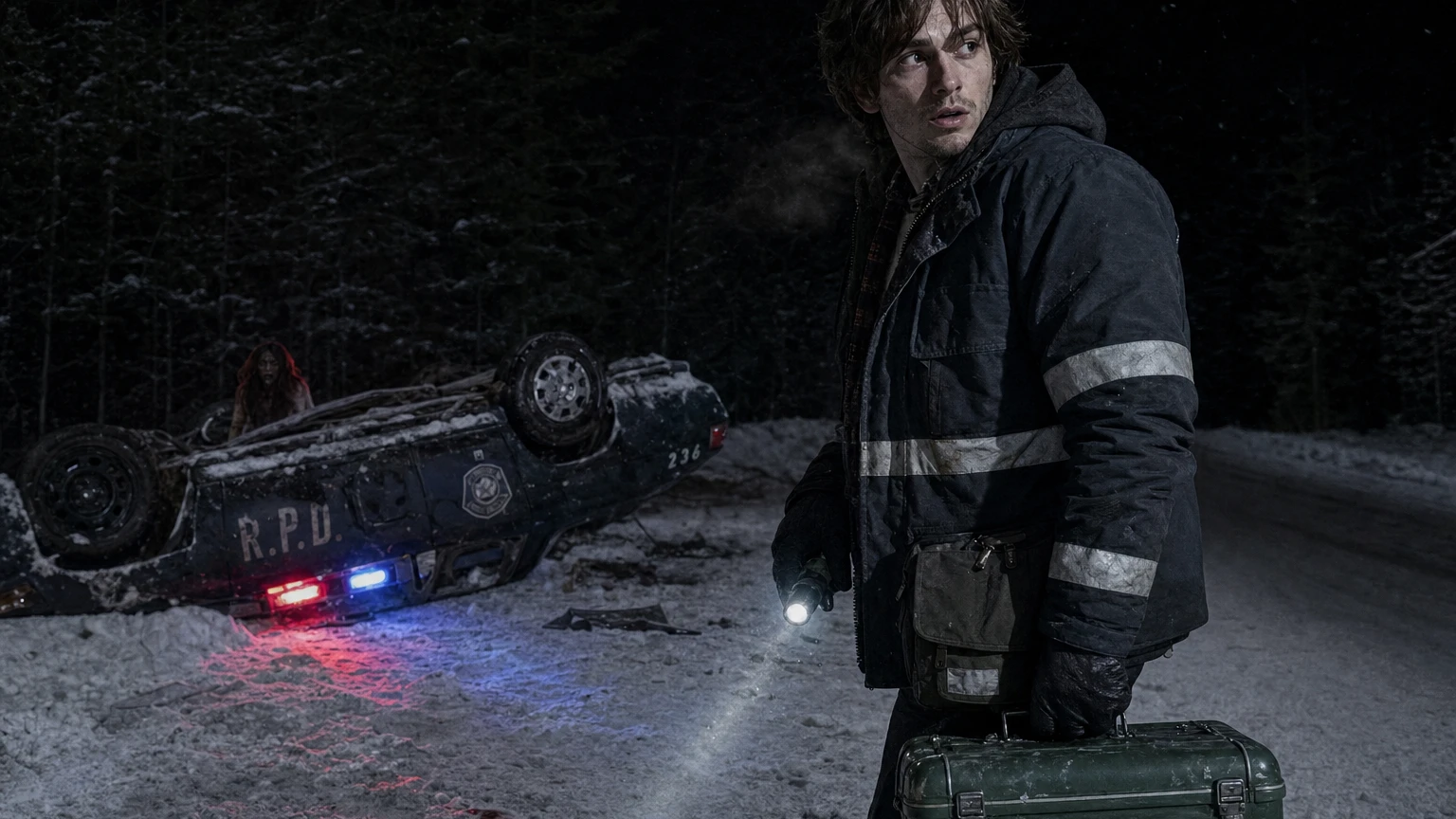
Zach Cregger’s Resident Evil opened in U.S. theaters Friday, September 18, with the kind of reviews this long-running movie franchise has rarely received. The new Sony release stars Austin Abrams as Bryan, an ordinary medical courier whose final delivery of the night sends him into a rapidly collapsing Raccoon City.
By Friday morning, Rotten Tomatoes listed the R-rated horror movie at 96% from 140 critics, while its first 500-plus verified audience ratings produced a 90% score. Those numbers will move as more reviews arrive, but the opening-day picture is clear: critics are responding to Cregger’s game-like construction, Abrams’ vulnerable lead performance and the film’s mix of gore, tension and dark comedy.
That does not make the reception unanimous. Some reviews have called it one of the strongest video game adaptations yet; others argue that its humor, intentionally simple story and escalating spectacle prevent it from becoming truly frightening. The useful dividing line for moviegoers is not whether it copies the games closely. It is whether a 90-minute survival run built around the experience of playing Resident Evil sounds more appealing than another direct retelling of Leon Kennedy’s story.
Resident Evil movie details at a glance
| Category | Details |
|---|---|
| U.S. release date | September 18, 2026 |
| Where to watch | Now playing in theaters; no home-streaming date has been announced |
| Director | Zach Cregger |
| Writers | Zach Cregger and Shay Hatten |
| Lead | Austin Abrams as Bryan |
| Cast | Zach Cherry, Kali Reis, Johnno Wilson and Paul Walter Hauser |
| Runtime | Approximately 90 minutes |
| Rating | R for strong bloody violence, gore and language throughout |
| Genre | Survival horror, action and dark comedy |
What the early Resident Evil reviews agree on
The strongest point of agreement is Abrams. Rather than playing a trained police officer, soldier or nearly indestructible action hero, he plays a courier who reacts to the outbreak with recognizably human confusion and fear. Bryan can run and improvise, but he does not suddenly become an expert because the plot needs him to survive.
That choice gives the action an unusual vulnerability. Viewers are not watching a professional clear rooms of infected creatures; they are watching someone struggle with weapons, make imperfect decisions and treat each new danger as a problem he might barely solve. Abrams’ panic also provides the film’s comedy without turning Bryan into a detached wisecracker.
Critics have also highlighted the structure. The movie follows Bryan across a succession of hostile spaces during one disastrous winter night. New locations introduce new threats, creating the cinematic equivalent of moving through game levels. The setting changes before any single scenario can settle into a conventional zombie siege.
The approach explains why several reviews have described the movie as unusually faithful despite its original protagonist. Its connection to the games is expressed through progression, limited resources, changing environments, escalating monsters and a lead character forced to keep moving. It does not depend on recreating familiar cutscenes.
Why some critics are stopping short of calling it great
The same design that has excited supporters accounts for most of the reservations. Bryan’s journey is intentionally direct, leaving less room for a complicated plot or a large ensemble. Viewers looking for mythology-heavy storytelling may find the movie slight beneath its craft and momentum.
The balance of horror and comedy is another potential fault line. The Associated Press praised how Abrams’ humor releases pressure without destroying the danger around him. Time Out offered a more qualified three-star response, arguing that the film is more goofy and visually impressive than genuinely scary.
That contrast is useful. Resident Evil appears built to deliver repeated bursts of dread, body horror and violent release rather than 90 uninterrupted minutes of oppressive terror. Its tone is closer to a gruesome amusement ride with a frightened, funny protagonist than a solemn zombie drama.
The larger claims calling it the best video game movie ever should also be treated as individual verdicts, not an established fact. What can be said on opening day is that multiple critics have independently made that argument, and that the movie’s aggregate reception is far stronger than the franchise’s live-action history would have led audiences to expect.
How Cregger’s movie differs from earlier Resident Evil films
This is neither a continuation of the six-film Milla Jovovich series nor a sequel to 2021’s Resident Evil: Welcome to Raccoon City. It is a new entry with a new lead, a separate approach and no requirement to remember the previous movies.
It also differs from Welcome to Raccoon City, which combined characters and events from the early games into a more recognizable adaptation. Cregger chose not to retell Leon, Claire Redfield or Jill Valentine’s stories. His position has been that the games already tell those stories effectively and that copying them would risk producing a redundant, compressed version.
Instead, he conceived Bryan’s mission as a story taking place around the edges of the kind of outbreak depicted in Resident Evil 2. Cregger has described it as a parallel perspective rather than a scene-for-scene adaptation, with some details altered for dramatic purposes.
That distinction matters for longtime fans. The film uses Raccoon City, the Umbrella Corporation, the viral outbreak and other recognizable elements, but its central characters and immediate mission are original. Anyone buying a ticket specifically to see Leon’s police-station ordeal recreated should reset that expectation before the lights go down.
The movie adapts Resident Evil’s mechanics, not its campaign
Cregger’s most interesting decision was to translate gameplay rules into the screenplay. He has said his early experience with Resident Evil 2 was defined by resource conservation: counting bullets, tracking healing items and deciding what could safely be left behind.
The film applies that philosophy to Bryan. His equipment develops as his situation worsens, moving from basic weapons toward greater firepower. Injuries and ammunition remain relevant rather than disappearing between action sequences. Cregger also reproduced recognizable healing items and planted visual references for players to identify.
The journey itself draws from the rhythm of Resident Evil 4. Bryan moves from point A to point B through locations that each contain a distinct danger. That creates forward momentum while preserving the franchise’s cycle of exploration, confrontation, temporary relief and escalation.
There is also a deliberate player-avatar quality to Bryan. He is not meant to replace Leon as a franchise icon. He represents the person holding the controller: familiar with the idea of guns and monsters, perhaps, but poorly prepared to encounter either in reality.
Is Resident Evil worth seeing? A spoiler-free verdict from the evidence
The early critical and audience response makes Resident Evil a comparatively safe theatrical choice for viewers who want a fast, violent and accessible horror movie. Its short runtime, self-contained premise and original protagonist reduce the amount of franchise knowledge required.
It appears especially well suited to three groups:
- Game fans interested in survival-horror mechanics: The film emphasizes resource pressure, weapon progression, vulnerable movement and rapidly changing threats.
- Viewers who liked Barbarian or Weapons: Cregger again uses tonal shifts and humor inside an increasingly violent horror scenario, although this production is more openly tied to franchise expectations.
- Newcomers: Bryan enters the outbreak with little understanding of what is happening, allowing the audience to learn alongside him.
There are equally clear reasons to hesitate. Fans wanting a faithful dramatization of a specific game campaign will not get one. Viewers seeking restrained psychological horror may find the action, jokes and gore too broad. The R rating is meaningful rather than incidental, so this is not a softened gateway adaptation for younger players.
For anyone waiting to watch at home, theaters are currently the only legitimate option. Sony has not announced a digital purchase, rental or subscription-streaming date.
Strong reviews raise the stakes for opening weekend
The critical response arrives as the film attempts to set a new domestic opening record for the franchise. Boxoffice Pro entered the weekend forecasting between $40 million and $50 million in North America.
The existing record belongs to 2010’s Resident Evil: Afterlife, which opened with approximately $26.65 million domestically. A debut inside the current forecast range would clear that mark comfortably, although projections are not results and the first reliable weekend estimate will not arrive until Sunday.
A strong launch would carry implications beyond one horror series. Studios have repeatedly struggled to decide whether video game movies should duplicate game narratives, use recognizable characters in new plots or preserve only the world and tone. Cregger’s movie is testing a fourth path: an original side story designed to reproduce the player’s moment-to-moment experience.
If that approach connects with both critics and paying audiences, it could give publishers and filmmakers more freedom to explore established game worlds without replacing or condensing their best-known stories.
What to watch after opening day
The first major test is whether verified audience scores remain close to the positive critical consensus as the sample expands. The most enthusiastic professional reviews have celebrated precisely the changes that concerned some fans before release, particularly the absence of Leon and other central game characters. Broader audience data will show whether moviegoers view those changes as creative freedom or a missed opportunity.
The second test is the box office. Passing Afterlife’s opening record would establish immediate commercial momentum, but the more important measure will be how well the film holds during its second weekend. Horror movies can open strongly and fall quickly; sustained business would indicate that word of mouth is reaching beyond Cregger’s following and the existing Resident Evil audience.
Finally, there is the question of what comes next. No sequel has been formally announced. The movie’s original characters and parallel-story framework would nevertheless give Sony, Constantin Film and PlayStation Productions several options if it succeeds: continue Bryan’s story, follow another ordinary survivor or shift toward familiar game heroes.
For now, the immediate development is significant enough: after seven earlier live-action theatrical films and years of arguments over how the games should be adapted, Resident Evil has opened with unusually strong critical support. Whether it becomes the franchise reset its reviews suggest will be decided by audiences beginning this weekend.
Make YouTube smarter with NextWatch AI
Use AI search, smarter discovery, playback tools and speed testing directly in your browser.
Add NextWatch AI to Chrome ↗