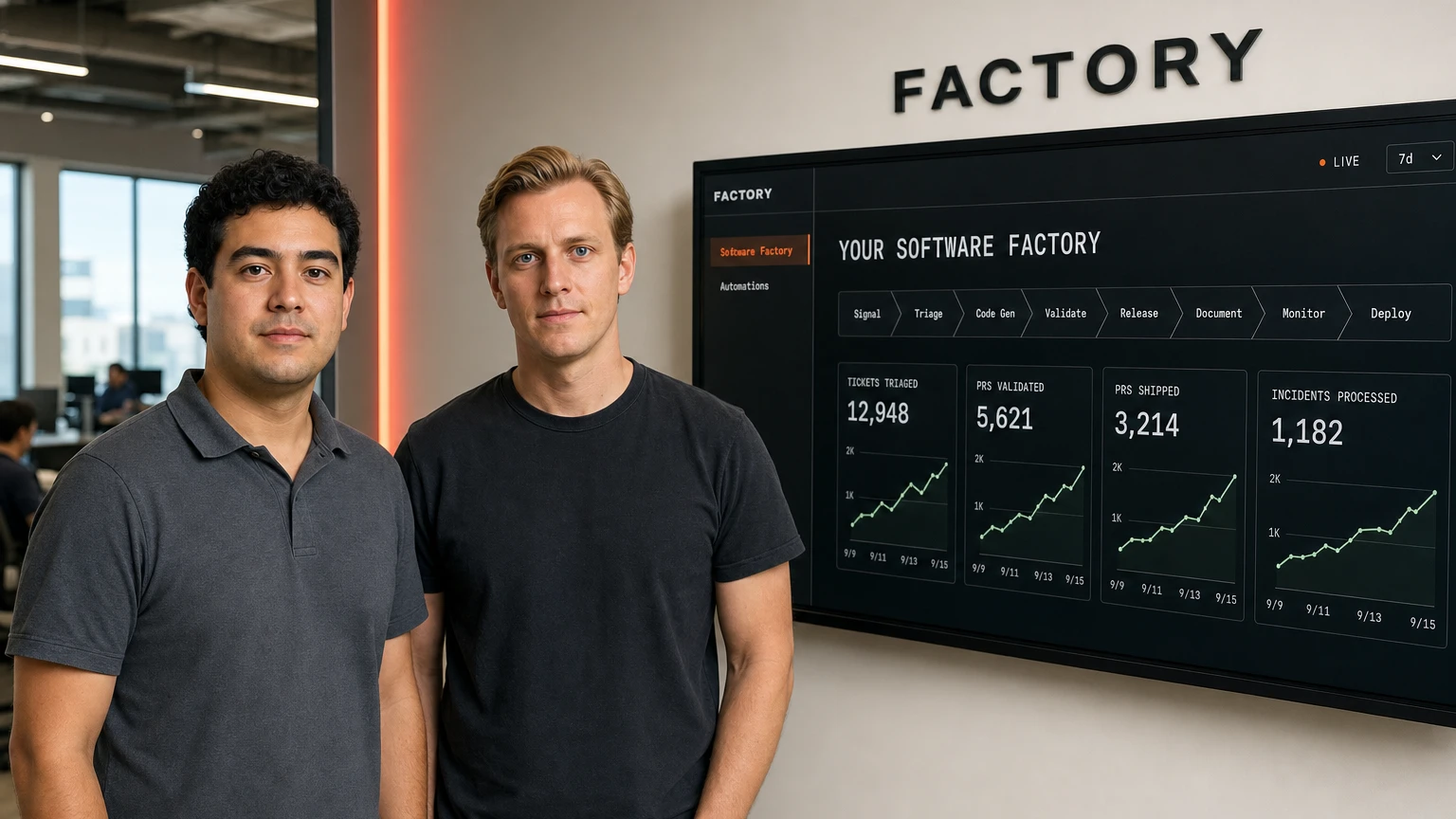
Factory said Tuesday, September 15, that it raised $200 million at a $5 billion valuation, giving the three-year-old AI coding company fresh capital to expand its enterprise platform and more than tripling its valuation in five months.
The financing included Blackstone, Khosla Ventures, Sequoia Capital, Insight Partners, Evantic Capital, Sound Ventures, NEA, Mantis VC and Clearlake. Factory said it will direct the money toward research, product development and its global go-to-market operation.
The immediate significance is not simply that another AI startup received a large valuation. Factory is asking investors and corporate technology leaders to accept a broader commercial thesis: that large engineering organizations will graduate from giving individual developers coding assistants to operating centrally governed systems of specialized agents across the software lifecycle.
Those systems are what Factory calls software factories. The new investment values the company as a potential control layer for enterprise software work, not merely another interface for generating code.
Factory’s valuation has accelerated faster than its disclosed business metrics
The new financing follows a $150 million Series C announced on April 16 at a $1.5 billion valuation. Factory’s valuation has therefore increased by about 233% since April, while its two 2026 rounds have supplied a combined $350 million.
Its publicly announced financings now add up to $420 million, consistent with Factory’s statement that it has raised more than $400 million.
| Date | Round | Amount | Announced valuation |
|---|---|---|---|
| November 2023 | Seed | $5 million | Not disclosed |
| June 2024 | Series A | $15 million | $120 million |
| September 2025 | Series B | $50 million | $300 million |
| April 2026 | Series C | $150 million | $1.5 billion |
| September 2026 | Not identified | $200 million | $5 billion |
The latest announcement did not identify a lead investor, label the financing as a Series D or specify whether the $5 billion figure is a pre-money or post-money valuation. It also did not disclose revenue, annual recurring revenue, the number of paying companies or the size and duration of its enterprise contracts.
That makes the valuation increase a strong signal of investor demand, but not by itself proof that customer spending or production output has risen at the same pace. Factory said in April that its revenue had doubled month over month for six consecutive months, but it did not provide a starting figure or an updated revenue number this week.
What Factory means by a ‘software factory’
Factory began by selling AI software-engineering agents called Droids. Its newer pitch is that isolated agents and coding assistants are insufficient for large organizations because they do not automatically share policies, context, evaluations or operational history.
The company’s software-factory model places multiple types of engineering work on one platform. Depending on the deployment, agents can help with planning, implementation, testing, code review, security analysis, documentation, maintenance and incident response.
Factory formally laid out that strategy in its June 15 Factory 2.0 announcement. The central idea is that signals such as bug reports, support conversations, internal tickets and business requirements can enter a shared system, where agents perform work under rules established by the company and its engineers.
- Shared organizational context: Agents working on different stages of development can use the same repository knowledge, instructions and workflow history.
- Model routing: Different tasks can be assigned to different AI models according to cost, speed or expected performance.
- Central governance: Administrators can restrict model access, network access, commands, tools and maximum autonomy levels.
- Flexible deployment: Factory supports cloud-managed, hybrid, on-premises and fully air-gapped configurations.
- Measurement: Analytics are intended to connect agent use and spending with engineering artifacts such as issues, projects and pull requests.
This is more ambitious than autocomplete or a chatbot answering questions about a codebase. It also creates more risk. An agent that can edit files, execute commands, interact with development tools and potentially prepare deployments requires stricter identity, permission, auditing and approval controls than an assistant that only suggests text.
Why the enterprise features matter more than the coding demo
AI coding products can appear similar when judged through demonstrations or standardized programming tests. The enterprise buying decision is harder: a customer must determine where an agent runs, what data it can reach, what actions it may take, which model handles each request and who is responsible when its output fails.
| Enterprise problem | Factory’s proposed response | What buyers still need to establish |
|---|---|---|
| Dependence on one model provider | Model-independent platform and automatic task-level routing | Whether quality and cost remain consistent as models change |
| Sensitive source code and regulated workloads | Hybrid, local and air-gapped deployment options | The security review, support model and operational burden for each deployment |
| Uncontrolled agent actions | Autonomy ceilings, command policies, blocklists, approvals and sandboxing | How controls perform during complex, real-world workflows |
| Difficulty proving return on AI spending | Agent Effectiveness analytics linking activity to issues and pull requests | Whether the attribution method isolates the agent’s contribution |
| Disconnected coding tools | One system spanning multiple software-development functions | The cost and organizational effort required to standardize workflows |
Factory’s enterprise controls allow organization administrators to set hard limits on available models and autonomy. Lower-level project or user settings can operate within those boundaries but cannot override the organization’s maximum permissions or weaken centrally managed restrictions.
That governance layer could become Factory’s most durable commercial asset. Foundation models change quickly, and enterprises may want to replace one provider with another without redesigning every agent workflow. Factory is betting customers will keep its orchestration, policy and measurement system even when the underlying models change.
Model independence does not eliminate lock-in, however. A company can still become dependent on Factory-specific workflow definitions, analytics, integrations and operating procedures. Buyers will have to weigh the flexibility of swapping models against the cost of moving the surrounding control layer.
Factory’s adoption and performance figures remain company claims
Factory says hundreds of thousands of developers use its technology and names Nvidia, Blackstone, Royal Bank of Canada, Palo Alto Networks, Adobe and T-Mobile among organizations building software factories with the platform.
The announcement does not show how broadly Factory is deployed inside each company, whether every named organization is a paying customer, or how much revenue those relationships produce. Some related partnerships are publicly visible, including an integration with Palo Alto Networks’ Prisma AIRS security platform, but the scope of Factory’s deployments cannot be inferred from a customer list alone.
Factory CEO Matan Grinberg described the market as moving “from individual coding agents to software factories.”
The company also says Factory Router has reduced token spending by more than 60% while maintaining frontier performance. Factory’s current product documentation presents a separate figure of 43% aggregate cost savings compared with pricing the same workload at top-tier model rates. Token reduction and total cost savings use different measurements, so the two percentages are not directly comparable; both originate from Factory’s own evaluations.
Its Agent Effectiveness product is designed to measure changes in project, issue and pull-request cycle times and to attribute completed work to agent sessions. That capability directly addresses a problem facing technology executives who can see AI usage rising but cannot reliably show what the spending produced.
Agent Effectiveness is still listed as a private-preview feature. Factory also warns that its attribution and output views cover only the source-control, project-management and issue-tracking systems connected by a customer. Incomplete integrations could therefore produce an incomplete picture of performance.
The competitive benchmark is rising quickly
Factory’s financing arrived one week after Cognition, the company behind the Devin coding agent, announced more than $2 billion in funding at a $48 billion valuation. Cognition said its annualized run-rate revenue was approaching $900 million.
The companies are not identical, and their self-reported revenue or usage measurements may not be directly comparable. Still, Cognition’s disclosure illustrates the evidence investors and enterprise buyers will increasingly expect from highly valued coding-agent businesses: revenue scale, usage growth, customer expansion and measurable output rather than benchmark scores alone.
Factory’s $5 billion valuation suggests investors believe there is room for a company focused on the governed enterprise layer, even as larger competitors pursue autonomous software engineering. The next test is whether Factory can demonstrate that its approach produces repeatable gains across many customers, not only striking results from selected workflows.
What the funding changes for customers and engineering teams
The round gives Factory more resources to hire researchers, expand its forward-deployed engineering teams and support complex installations. That matters because deploying an autonomous system across a large company is partly a software sale and partly an organizational transformation project.
Factory has also been reducing procurement friction. It is available through cloud and AI-provider marketplaces, allowing some enterprises to purchase it using existing spending commitments rather than opening an entirely separate vendor cycle. Combined with the new global go-to-market investment, that strategy indicates Factory is prioritizing distribution and large-company standardization alongside technical development.
For technology leaders
- Evaluations are likely to expand from code-generation quality to cost per completed issue, pull-request cycle time, failure rates, review burden and incident recovery.
- Security teams will need policies for agent credentials, command execution, network access, model selection and human approval.
- Companies may have to improve testing, documentation and development environments before autonomous agents can work reliably.
For developers
- More work may be delegated as longer-running tasks rather than completed through line-by-line suggestions.
- Engineers remain responsible for defining workflows, reviewing outcomes and deciding how much autonomy is appropriate.
- Poorly documented repositories and slow feedback loops can limit agent performance regardless of which underlying model is used.
The funding does not establish that software teams are about to become fully autonomous or that companies can safely remove human engineering oversight. Factory itself describes autonomy as a gradual process that depends on each organization’s systems, readiness and tolerance for risk.
What to watch next
- Commercial disclosure: Revenue, paid-seat growth, contract values and customer retention would show whether the business is scaling alongside its valuation.
- Agent Effectiveness availability: A broader release could reveal whether Factory can turn its measurement pitch into a differentiating product.
- Referenceable deployments: Detailed customer accounts will matter more than logo lists, particularly in banking, telecommunications and security-sensitive environments.
- Router economics: Buyers will want reproducible evidence that automatic model selection lowers total cost without shifting additional work to human reviewers.
- Safety at higher autonomy: The crucial question is how governance controls perform when agents execute long, interconnected workflows rather than isolated coding tasks.
- Platform standardization: Factory must prove enterprises prefer one governed software-development layer over assembling agents, models and internal tools themselves.
Factory’s new capital gives it time and reach to pursue that argument. The $5 billion valuation shows investors are already assigning substantial value to the enterprise control layer around coding agents. Whether “software factories” become a lasting category will depend on evidence that they can deliver secure, measurable software output at organizational scale.
Make YouTube smarter with NextWatch AI
Use AI search, smarter discovery, playback tools and speed testing directly in your browser.
Add NextWatch AI to Chrome ↗