
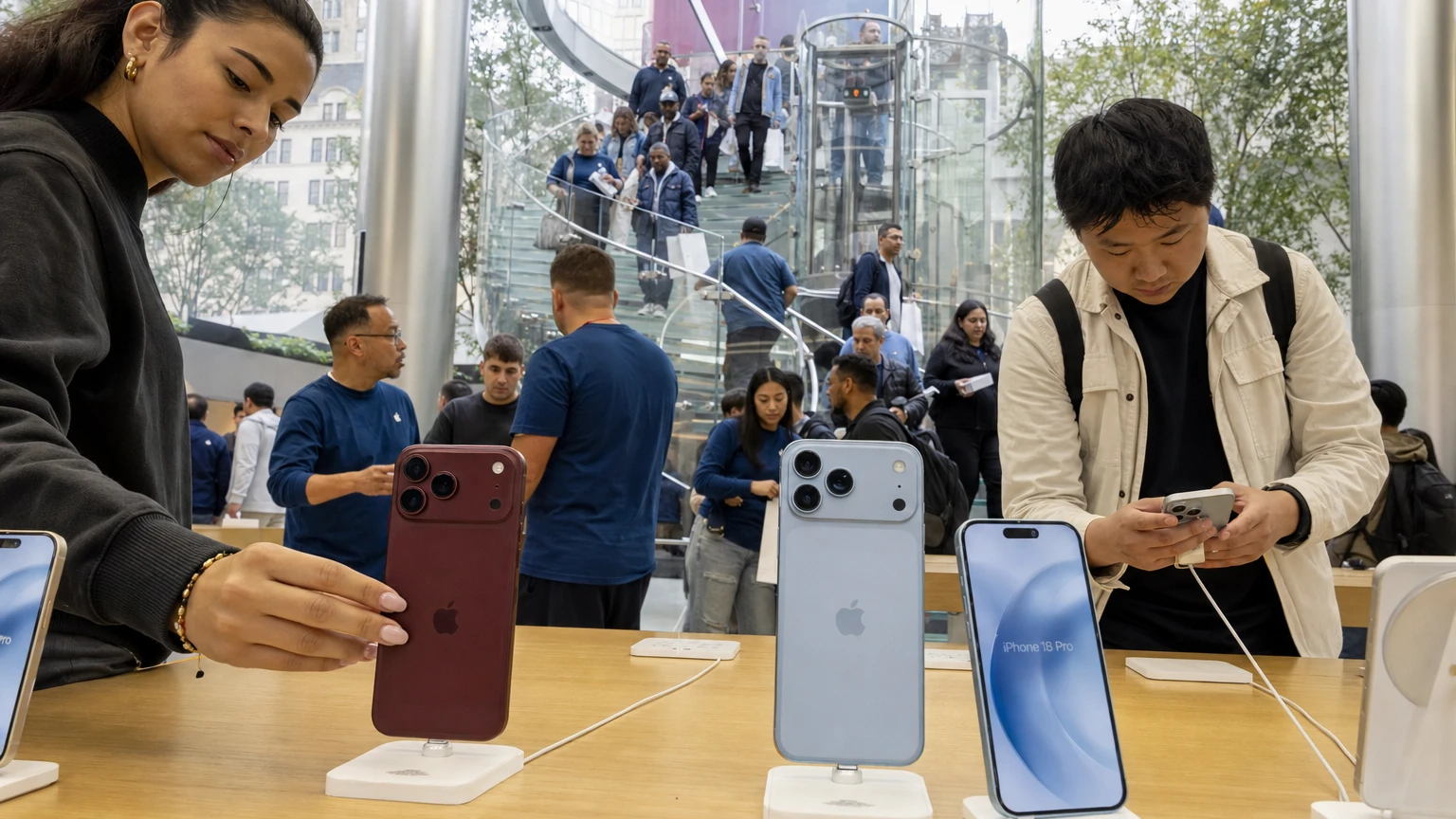
Apple’s iPhone 18 Pro and iPhone 18 Pro Max went on sale Friday, September 18, in the United States and more than 65 other countries and regions. The phones start at $1,199 and $1,299, respectively, but buyers who did not preorder may find that securing the exact color and capacity they want requires more planning than walking into a store.
Apple is accepting orders through its website and the Apple Store app, while its retail stores, major U.S. carriers and participating electronics retailers are handling launch-day sales. Direct-to-home shipping estimates for many configurations have already moved beyond launch day, particularly for the Pro Max, making local pickup inventory the best immediate option in some cities.
The decision itself is relatively simple: both models have the same core performance and camera features, while the Pro Max buys a larger screen and longer battery life at the cost of additional weight and at least $100. The complications come at checkout, where eSIM requirements, charger compatibility and multiyear carrier credits can change the real cost of the purchase.
Launch-day stock is available, but it is highly local
A launch-day availability check by MacRumors found estimated U.S. delivery waits of roughly two to three weeks for many iPhone 18 Pro configurations and three to four weeks for the Pro Max. Those shipping estimates do not necessarily reflect inventory reserved for Apple Store pickup.
Apple releases pickup stock by individual store, color and storage capacity. A phone that appears unavailable for delivery may therefore be ready for collection nearby, while a configuration available across town may be absent from the closest store.
- Configure the phone online first. Choose the model, color, storage and carrier connection through Apple’s site or app.
- Select pickup before paying. Enter a ZIP code and compare several stores rather than checking only the nearest location.
- Reserve a time window. If stock appears, complete payment and select the available check-in period. Seeing inventory on a product page does not reserve it.
- Wait for confirmation. Do not travel to the store until Apple says the order is ready.
- Check again later if necessary. Canceled reservations and additional inventory can produce openings during the day or over the launch weekend.
Walk-in purchases may be possible where a store has unreserved stock, but Apple does not guarantee availability. Customers without pickup orders may also be placed in a separate queue, making a confirmed online reservation the safer route.
What to bring for an Apple Store pickup
Apple advises customers to bring the order number and a valid government-issued photo ID. An unlocked phone can generally be collected by the purchaser or a designated pickup contact. A phone being upgraded or financed through a carrier may need to be collected by the primary account holder or an authorized user, depending on carrier rules.
Carrier stores and retailers such as Best Buy maintain separate allocations, so they are worth checking when Apple has no nearby stock. Availability, eligible payment methods and trade-in values can differ by seller.
iPhone 18 Pro versus Pro Max at a glance
| Feature | iPhone 18 Pro | iPhone 18 Pro Max |
|---|---|---|
| Starting U.S. price | $1,199 | $1,299 |
| Starting storage | 256GB | 256GB |
| Other storage options | 512GB, 1TB, 2TB | 512GB, 1TB, 2TB |
| Display | 6.3-inch OLED, 120Hz ProMotion | 6.9-inch OLED, 120Hz ProMotion |
| Weight | 7.44 ounces, or 211 grams | 8.78 ounces, or 249 grams |
| Apple-rated typical use | Up to 24 hours | Up to 30 hours |
| Apple-rated video playback | Up to 36 hours | Up to 45 hours |
| Rear cameras | Three 48MP cameras | Three 48MP cameras |
| Chip | A20 Pro | A20 Pro |
| Colors | Black, silver, glacier, burgundy | Black, silver, glacier, burgundy |
The Pro Max does not unlock a superior camera system or an exclusive processor. Its practical advantages are the 6.9-inch display and larger battery. The smaller Pro is easier to use one-handed and is 38 grams lighter, a difference that will be noticeable during long reading, filming or navigation sessions.
Both phones begin with 256GB and can be configured with up to 2TB. The arrival of a 2TB option on the smaller Pro is useful for creators recording large ProRes files, but most buyers should not pay for that capacity automatically. Anyone primarily storing photos in iCloud and streaming music or video will usually find 256GB or 512GB more economical.
The meaningful upgrades over the iPhone 17 Pro
The iPhone 18 Pro family carries a $100 higher starting price than the equivalent iPhone 17 Pro models did at launch. Apple has kept the same 6.3-inch and 6.9-inch screen sizes and broadly similar exterior design, so the value of the upgrade is concentrated in the camera, battery, charging and sustained performance.
A variable-aperture camera comes to the iPhone
The headline hardware change is a six-blade variable aperture in the 48MP Fusion Main camera. It can switch among four settings, from f/1.48 to f/4.0, to alter how much light reaches the sensor and how much of a scene remains in focus.
The phone can manage the aperture automatically, meaning casual photographers do not need to operate it manually. The benefit becomes clearer in difficult conditions: a wide aperture can gather more light or create stronger background separation, while a narrower setting can preserve detail across a group photograph or landscape.
New Pro controls also place aperture, shutter speed, white balance and a histogram inside Apple’s Camera app. That reduces the need for third-party software when a photographer wants more control than automatic mode provides. Apple has paired the main camera with 48MP ultra-wide and telephoto cameras, including up to 8x optical-quality zoom.
Early independent testing has found stronger low-light results and a visible difference in depth of field between aperture settings. Still, people who rarely move beyond automatic snapshots may experience the change as a refinement rather than a reason to replace a one-year-old phone.
Battery life improves, although real-world gains may be smaller than the headline
Apple rates the iPhone 18 Pro for up to 36 hours of video playback, up from 33 hours on the 17 Pro. The Pro Max rating rises from 39 to 45 hours. Apple also publishes typical-use estimates of 24 hours for the Pro and 30 hours for the Pro Max.
Standardized testing by Tom’s Guide produced a more modest generational change. Its continuous cellular web-browsing test averaged 16 hours and 17 minutes for the iPhone 18 Pro, compared with 15 hours and 21 minutes for the 17 Pro. The Pro Max averaged 18 hours and 27 minutes, 33 minutes longer than its predecessor.
Those results still make battery life a genuine upgrade, particularly on the smaller model, but buyers should not interpret Apple’s video-playback numbers as a promise that every workload will improve by the same amount.
The A20 Pro focuses on sustained speed and heat
Both phones use Apple’s A20 Pro chip alongside a redesigned vapor chamber with three times the surface area of the previous generation. Apple says the combination can deliver up to 40% better sustained performance than the iPhone 17 Pro.
This matters more for extended gaming, video production and on-device AI processing than it does for messaging or browsing. Early reviewers have reported that the phones can still become warm under heavy use, but that heat is spread and dissipated more effectively than on the previous Pro generation.
Siri AI is included, but it remains a beta feature
The iPhone 18 Pro ships with iOS 27 and supports Apple’s more personalized Siri AI, including onscreen awareness, personal context and actions based on content from messages, email and photos. Apple is still describing Siri AI as a beta rollout, however, and feature availability depends on language and region.
That distinction matters for anyone treating AI as the primary reason to upgrade. The hardware is designed for more on-device intelligence, but the usefulness of individual Siri features will depend on software maturity and app support after launch. Our guide to Siri AI’s supported devices and current limitations explains the rollout in more detail.
Five checkout details that could change the real price
1. U.S. models are eSIM-only
The U.S. iPhone 18 Pro and Pro Max do not accept physical SIM cards. They can keep two eSIMs active and store additional profiles, but buyers should verify that their carrier and any international travel provider support eSIM before transferring service.
Anyone moving from a much older phone or a small prepaid carrier should resolve compatibility before erasing or trading in the existing device.
2. The fastest charging requires a new class of adapter
Apple says either model can reach approximately 50% charge in 15 minutes when paired with a 60W-capable USB-C adapter supporting Adjustable Voltage Supply. That adapter is sold separately.
The box contains the iPhone and a one-meter USB-C charging cable, not a wall charger. Existing USB-C adapters should still charge the phone, but older or lower-wattage models may not deliver the advertised speed. MagSafe and Qi2 charging reach up to 25W, with Apple estimating a 50% charge in about 30 minutes using compatible equipment.
3. “Up to $1,200 off” is rarely an instant discount
Apple advertises direct trade-in credit of $175 to $885 for eligible iPhone 13 or newer models. Carrier promotions can reach $1,200, but the largest offers generally require a qualifying trade-in, an eligible premium plan and continued service for 24 or 36 months.
For example, AT&T’s top promotion is distributed through 36 monthly bill credits and requires a qualifying plan. T-Mobile’s advertised savings also depend on the plan, trade-in or new-line combination and are paid through monthly credits. Canceling service, upgrading early or paying off a device ahead of schedule may stop remaining promotional credits.
Buyers should compare the total plan cost over the full credit period, not just the advertised monthly phone payment. Taxes on the phone’s full price and activation or connection fees may also be due at purchase.
4. The financing method can affect whether the phone is unlocked
Apple says an iPhone purchased at full price or financed through an Apple financing option is unlocked for use with compatible carriers. Phones financed through AT&T, T-Mobile or Verizon may remain locked to that carrier until their payment requirements are satisfied.
Frequent international travelers and customers who expect to switch networks should confirm the unlocking policy before accepting a promotion.
5. Complete the transfer before surrendering a trade-in
Make a current encrypted backup or iCloud backup, verify access to the Apple Account and confirm that important authenticator apps can be restored. Do not erase the old phone until calls, messages, photographs, passwords and two-factor authentication methods are working on the new device.
Apple provides temporary iCloud storage for eligible device-to-device transfers, while direct Apple purchases include access to Personal Setup assistance.
Who should choose each model?
- Choose the iPhone 18 Pro if portability matters, you want the full camera system, or you find large phones tiring to hold. It offers nearly all the Pro Max experience in a lighter body.
- Choose the iPhone 18 Pro Max if battery endurance and a large screen outweigh the 249-gram weight. It is the better fit for frequent travelers, heavy video viewing and long shooting days.
- Upgrade from an iPhone 15 Pro or older if the combined improvements in battery life, cooling, display visibility and camera control address real limitations in the current phone.
- Think carefully before replacing an iPhone 17 Pro unless variable aperture, faster charging or longer sustained performance is important. The exterior dimensions and basic display experience have changed little.
- Consider a less expensive model if the Pro camera and processor are unnecessary. Apple’s current store lists the iPhone 17 from $899, leaving a $300 gap below the new Pro.
Buyers considering Apple’s foldable should also remember that it is not part of today’s retail launch. The $1,999 iPhone Duo is scheduled to reach customers on October 23. Our iPhone Duo buying analysis compares that later release with Apple’s conventional Pro phones.
What to watch after launch weekend
Pickup inventory will remain fluid as Apple redistributes stock and unclaimed reservations return to the system. Buyers who are flexible on color or storage will have a better chance of finding a nearby phone, while Pro Max shoppers may face the longest direct-shipping waits.
The other key variable is software. Early iOS 27 updates, third-party support for the variable-aperture camera API and changes to the Siri AI beta will determine how quickly the phones’ most ambitious features become broadly useful.
For anyone buying today, the safest approach is to reserve pickup before leaving home, select a model based on size rather than an assumed camera advantage, and calculate carrier offers across their entire term. The iPhone 18 Pro launch is underway; getting the right version at the right price requires looking past the launch-day headline.
Make YouTube smarter with NextWatch AI
Use AI search, smarter discovery, playback tools and speed testing directly in your browser.
Add NextWatch AI to Chrome ↗