
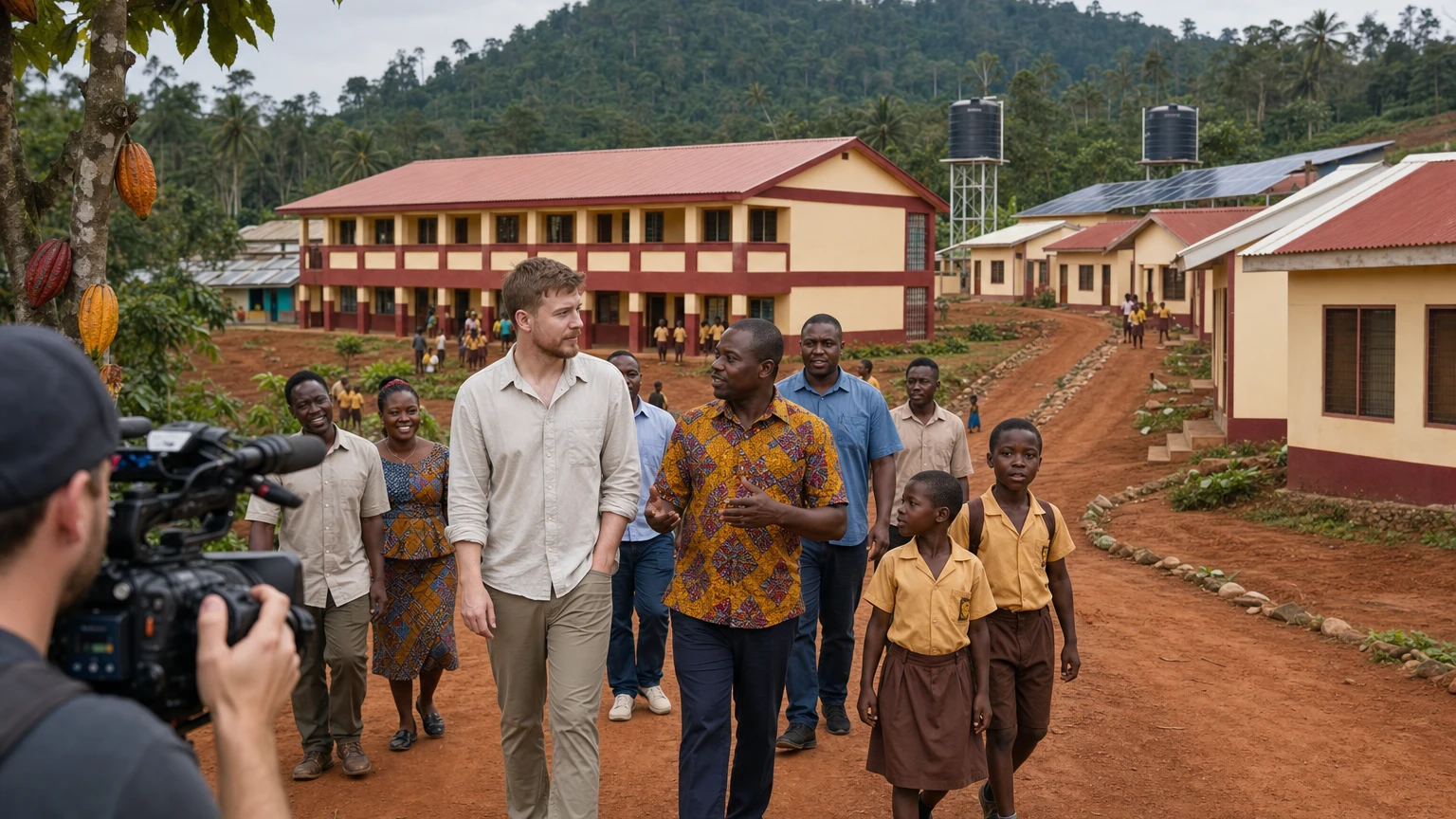
MrBeast released his self-described $10 million YouTube production on Saturday, September 19, revealing that the project was not another elimination contest or oversized survival stunt but the construction of a village in Ghana intended to help children leave hazardous cocoa-farm work and attend school.
The 19-minute upload, titled I Built A City To Save Kids From Illegal Labor, follows Jimmy Donaldson and his partners as they build Abna Dakwa Village. The project includes a school for more than 300 students, 10 homes for teachers, clean-water systems, solar power, a market, agricultural facilities, recreation areas and community services.
Donaldson had kept the premise secret when he announced the video on September 16. At the time, he said it had been in development for years, required more than 1,000 hours of his personal time and cost around $10 million. No independently audited budget or line-item breakdown has been released, so that figure remains Donaldson’s stated expenditure rather than a verified production total.
Public channel trackers placed the upload above 20 million views during its first day. Its longer-term performance will matter more, however, because the production arrives as Beast Industries tries to prove that extraordinarily expensive content can support a diversified company spanning entertainment, consumer products, software, financial services and philanthropy.
What MrBeast’s $10 million project built
The finished project is closer to a newly developed village or community hub than a city in the conventional municipal sense. The word “city” is the packaging used in the YouTube title; the settlement itself is identified in coverage of the project as Abna Dakwa Village.
| Project element | What has been disclosed |
|---|---|
| Stated cost | Approximately $10 million, according to Donaldson; no public audited breakdown has been provided |
| Location | Ghana, within a wider Beast Philanthropy initiative focused on cocoa-growing communities in the country’s Eastern Region |
| Education | A new 10-classroom school designed to serve more than 300 students |
| Teacher housing | Ten homes intended to help attract and retain teachers |
| Utilities | Solar power, wells, water towers, household water connections and flood-control work |
| Community facilities | A market, community center with medical space, library, playground and football field |
| Food and livelihoods | A community farm, poultry facilities, fish tanks and five years of school meals |
The video description credits the 1 Billion Followers Summit, Mohammed Bin Rashid Global Initiatives and the Varkey Foundation as partners. It also identifies The Rockefeller Foundation as supporting school meals and the Global Energy Alliance for People and Planet as supporting solar power. Donaldson says the project will provide students with a free meal on every school day for five years.
The upload presents the village as part of a direct response to child labor in cocoa production. That underlying problem is extensively documented beyond Donaldson’s video. The U.S. Department of Labor estimates that more than 1.5 million children work on cocoa farms in Ghana and Côte d’Ivoire, with many exposed to hazardous tasks such as carrying heavy loads, using sharp tools and handling agricultural chemicals.
The upload is bigger than one village
Abna Dakwa is the visible centerpiece of a broader five-year Beast Philanthropy program in Ghana. The organization’s project plan covers 11 communities at different stages, combining schools and sanitation with farmer income, school meals, savings groups and child-labor monitoring.
The first five communities entered the program in September 2025. Beast Philanthropy says rebuilt schools, kitchens, boreholes, sanitation facilities and monitoring systems are now largely operating in those locations. Four additional communities are beginning their rollout, while two more remain planned for a later phase.
That distinction is important. A viral construction video can show buildings opening, but it cannot establish whether the intervention works over time. The meaningful measurements will be school attendance, child-labor recurrence, teacher retention, maintenance, household income and whether locally managed farms and markets become financially durable.
Beast Philanthropy says its monitoring uses the Child Labor Monitoring and Remediation System methodology, with field agents interviewing children and guardians, developing individual plans and conducting repeat visits. Its stated strategy also includes paying participating cocoa farmers a living-income reference price and organizing adult labor groups for harvest periods.
Why a $10 million upload can make business sense
The immediate financial equation is deliberately difficult to calculate from outside Beast Industries. The public does not know the project’s final cost allocation, YouTube advertising revenue, sponsorship terms, charitable contributions, tax treatment or the value of in-kind support supplied by partners.
That means claims that the video will either easily earn back $10 million or inevitably lose millions would be premature. View count alone is not revenue, and the geographic mix of the audience, advertising demand, watch time and commercial agreements can materially change what an upload earns.
But direct video profit is only one part of the calculation. A flagship MrBeast upload can simultaneously function as:
- A YouTube entertainment product generating advertising revenue over many years
- Premium inventory for brand integrations and commercial partners
- A global marketing channel for businesses owned by Beast Industries
- A demonstration of production capability to streamers and advertisers
- A fundraising and awareness vehicle for Beast Philanthropy
- A reputation-building asset for investors, retailers, employees and potential partners
This is the central advantage of the creator-business model Donaldson has built. The audience is not merely the customer for a piece of media. It is also a distribution network that can be directed toward chocolate, merchandise, software, television projects and charitable campaigns.
Traditional studios typically pay separately to create a show, distribute it and market it. Beast Industries owns the central personality, the production operation and direct access to an audience of more than 500 million YouTube subscribers. Spending heavily on the content can therefore replace some of the marketing expenditure that a conventional consumer company would need to buy elsewhere.
The Feastables connection raises the stakes
The subject of the video is particularly significant because Donaldson also owns Feastables, a chocolate and snack business. His attack on child labor in cocoa is therefore both a humanitarian message and a direct statement about how his consumer brand wants to compete.
Feastables says it purchases all its cocoa on Fairtrade terms, pays farmers the living-income reference price or the market price when that is higher, and works with cooperatives using child-labor monitoring and remediation systems. Tony’s Open Chain independently lists Feastables as a participating “mission ally.”
The Ghana project gives those sourcing commitments a physical and highly visible expression: classrooms, water systems, meals and alternative sources of community income. It also gives Feastables a point of differentiation in a crowded chocolate market where several established manufacturers publish their own responsible-sourcing and child-protection programs.
That overlap does not automatically invalidate the philanthropic work. A project can provide a public benefit while also strengthening a company’s brand. It does mean, however, that Donaldson’s claims will receive commercial as well as charitable scrutiny. Beast Industries is effectively asking viewers to judge Feastables not only by its products but by whether its supply-chain model produces measurable improvements.
A production budget far above normal YouTube scale
The $10 million figure stands out even by MrBeast standards. Donaldson’s recreation of Squid Game, one of the defining videos of his rise, reportedly cost about $4 million. More recent reporting has placed the typical budget for a main-channel video in the range of $3 million to $4 million.
If Donaldson’s latest figure is accurate, the Ghana project cost roughly two and a half to three times as much as one of those already expensive uploads. It also approaches the budget of an independent feature film, despite running for less than 20 minutes.
The comparison illustrates how misleading the phrase “YouTube video” can now be. At the top end of the creator economy, an upload may involve international construction, engineering, logistics, legal work, humanitarian partnerships, a large production crew and months of post-production. The finished file is short, but the organization behind it increasingly resembles a studio, consumer-goods company and marketing agency operating together.
Beast Industries must balance spectacle with financial discipline
The release comes during an important year for Beast Industries. TIME reported in April that the company employs about 750 people, has a valuation above $5 billion and expects to reach profitability for the first time in 2026. CEO Jeff Housenbold said the business had cut more than $100 million in operating expenses over 14 months after losing $500 million across the previous five years.
Donaldson, meanwhile, has continued to emphasize reinvestment. His willingness to pour revenue back into larger projects helped create the scale that competitors struggle to match, but it also creates a tension familiar to founder-led companies: the creative instinct to keep escalating must coexist with demands for predictable returns and tighter controls.
A $10 million upload does not necessarily contradict cost discipline. Beast Industries may regard a small number of exceptional productions as tent-pole investments while reducing waste elsewhere. But the project raises the standard by which future spending will be evaluated. Investors will want evidence that the attention generated by blockbuster videos strengthens the wider company, not only Donaldson’s personal channel.
That question has become more pressing since BitMine invested $200 million in Beast Industries in January. Outside capital gives the company more room to expand, but it also increases expectations that its vast reach can be translated into a durable and eventually profitable enterprise.
What this means for other creators
The lesson is not that every creator should spend more. Donaldson’s economics depend on a combination that few channels possess: enormous global reach, established sponsorship demand, owned consumer brands, reusable production infrastructure and access to outside capital.
For most creators, copying the expense without owning the businesses that benefit from the resulting attention would be financially dangerous. The more transferable lesson is vertical integration. Creators become less dependent on platform advertising when they own products, intellectual property or services that their content can distribute.
The project also demonstrates why packaging remains vital even at extreme production scale. Donaldson did not title the video as an institutional development program in Ghana. He reduced a complex intervention to a simple promise that can be understood from a thumbnail and a few words. The underlying work may be extensive, but YouTube still rewards an immediate idea.
What to watch next
- Long-term view performance: The first-day number shows curiosity. The 30-day and lifetime totals will indicate whether a serious humanitarian subject travels as widely as Donaldson’s competitions and survival videos.
- Financial disclosure: A fuller breakdown would clarify how much of the stated $10 million went to permanent infrastructure, video production, logistics, future meal commitments and partner-supported work.
- Measured outcomes: School attendance, household income and independently monitored child-labor cases will matter more than the opening ceremony.
- Feastables’ supply chain: The brand now has an unusually public standard against which its cocoa sourcing and farmer-pay commitments can be assessed.
- Beast Industries’ profitability: The company must show that giant productions can coexist with its stated goal of becoming financially sustainable in 2026.
The immediate revelation is that MrBeast’s “biggest YouTube video ever” is a Ghana development project rather than a conventional spectacle. The larger business story is that the difference between content, marketing, commerce and philanthropy has nearly disappeared inside Beast Industries.
If the village delivers lasting results, the upload could become one of Donaldson’s strongest demonstrations of how creator attention can finance real-world infrastructure. If the impact proves difficult to sustain—or if the business cannot support spending at this level—the same project will illustrate the risks of building an empire around ever-larger bets.
Make YouTube smarter with NextWatch AI
Use AI search, smarter discovery, playback tools and speed testing directly in your browser.
Add NextWatch AI to Chrome ↗