
Reviews for Silent Hill: Townfall landed Monday, September 21, giving players their first full critical verdict just three days before its standard September 24 release—and only hours before Deluxe Edition early access begins in the United States.
The initial consensus is positive but not unanimous. Critics widely praise developer Screen Burn Interactive’s oppressive recreation of a 1990s Scottish coastal community, its commitment to first-person psychological horror and a handheld CRT television that doubles as an enemy-tracking device. The sharpest disagreement centers on stealth: some reviewers found its pursuit sequences tense and rewarding, while others said inconsistent enemy behavior and punishing late-game encounters undercut an otherwise exceptional atmosphere.
Early aggregate scores were settling in the low 80s on Monday, although those figures remained fluid as additional reviews were added. Individual verdicts range from PC Gamer’s 89 and Game Informer’s 8.25 out of 10 to a more cautious 7 from CGMagazine and 3 out of 5 from VGC.
The result is not a simple must-buy or avoid verdict. Instead, the reviews describe an ambitious Silent Hill whose setting, sound and imagery may rank among the series’ best, but whose gameplay friction could determine whether players see it as a modern classic or a missed opportunity.
Silent Hill: Townfall review scores at a glance
| Outlet | Score | Central verdict |
|---|---|---|
| PC Gamer | 89/100 | A successful mixture of familiar psychological horror and new ideas built around the CRTV. |
| Game Informer | 8.25/10 | An affecting first-person entry that continues Silent Hill’s recent return to form. |
| IGN | 8/10 | A compelling, ominous mystery whose atmosphere and enemy encounters outweigh some shortcomings. |
| CGMagazine | 7/10 | A deeply engaging story and strong atmosphere weakened by frustrating design choices. |
| VGC | 3/5 | An immaculately realized setting undermined by aggravating stealth sequences. |
| Tom’s Guide | Editor’s Choice | A major series high point that successfully brings Silent Hill into first person. |
Those scores illustrate the unusual shape of the critical response. Reviews generally agree on what Townfall does well, but the severity assigned to its weaknesses varies dramatically. A frustrating sequence that one critic regarded as a temporary interruption became, for another, enough to pull the entire score down.
Critics agree that St. Amelia is the star
The most consistent praise belongs to St. Amelia, the fictional Scottish island community where the story unfolds in 1996. Simon Ordell washes ashore with little understanding of why he is there, only to find an apparently abandoned town buried beneath fog and connected to a past he cannot fully remember.
Screen Burn, the Glasgow studio previously known as No Code, modeled the location on communities along Scotland’s eastern coast. Reviews repeatedly highlight its weathered stone houses, shops, public telephones, aging computers and other period details. The setting is not merely a Scottish coat of paint applied to the traditional Silent Hill formula; critics found that the town’s economic decline, isolation and relationship with outside corporate interests give its horror a distinct identity.
VGC, despite delivering one of the lower scores, called St. Amelia one of the most meticulously detailed locations in the series. The Guardian similarly emphasized the specificity of its fishing-community setting, while TechRadar praised how naturally the recognizable streets, alleys and homes support exploration and stealth.
That agreement matters because Townfall does not take place in the American town that gave the franchise its name. Following Silent Hill f’s move to 1960s Japan, the new game further tests whether Konami can treat Silent Hill as a flexible anthology of guilt, trauma and supernatural punishment rather than a franchise permanently tied to one location.
On that question, the reviews are unusually decisive: Scotland works.
First-person horror and the CRTV make Townfall feel different
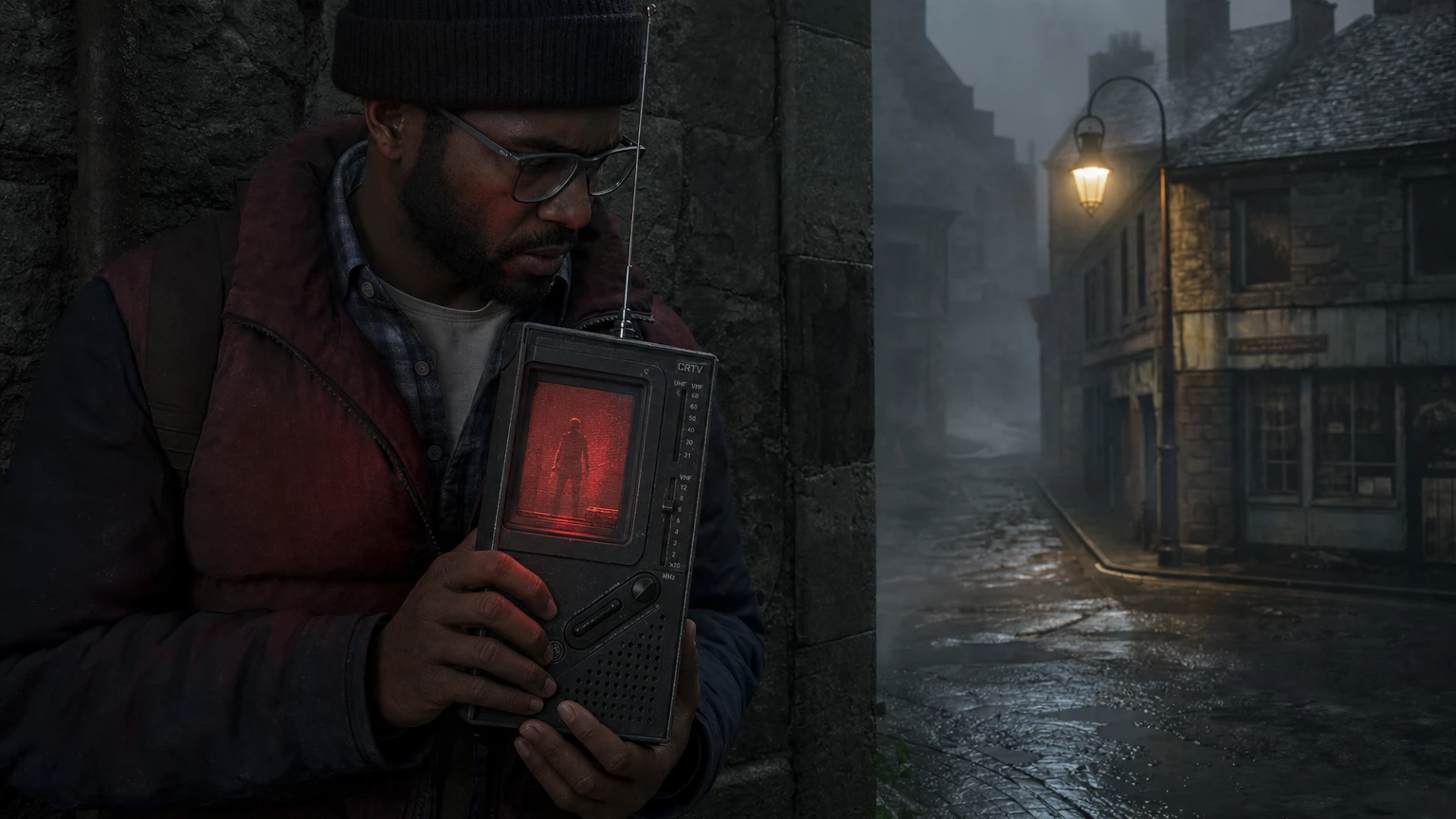
Townfall is the first full Silent Hill game designed primarily around a first-person viewpoint. Earlier projects experimented with the perspective, but Screen Burn uses it throughout the game to make St. Amelia’s narrow interiors, streets and hiding places feel immediate and claustrophobic.
The signature mechanic is Simon’s CRTV, a small portable television that replaces the series’ traditional enemy-detecting radio. Players tune the device to different frequencies to locate creatures through walls, examine distorted recordings and uncover clues. Because its picture is noisy and limited, looking at the television can provide essential information while obscuring the danger directly in front of Simon.
Critics generally see the device as an effective extension of Screen Burn’s fascination with analog technology, previously demonstrated in Stories Untold and Observation. PC Gamer praised it as both a puzzle-solving tool and a stealth mechanic, while Slant highlighted the anxiety produced by manually switching frequencies to determine what may be moving nearby.
There is a trade-off. IGN argued that being able to detect enemies can reduce the impact of some early scares. Other reviewers found that the degraded image and need to shift attention away from the environment preserve enough uncertainty to keep the device from becoming an all-purpose safety system.
Stealth is the critical dividing line
The disagreement becomes much sharper when Townfall forces players to evade its monsters.
Stealth is a major part of the game rather than an occasional alternative to combat. Players crouch behind vehicles and walls, peek around cover, use distractions and consult the CRTV before attempting to cross dangerous areas. Improvised melee weapons and firearms are available, but limited resources and weapon durability discourage fighting every creature.
TechRadar found the outdoor stealth sections thrilling, crediting St. Amelia’s alleys, hiding places and alternate routes with giving players meaningful freedom. Tom’s Guide also compared the tension favorably with Alien: Isolation, particularly when an apparently unkillable enemy enters the pursuit.
VGC reached a very different conclusion. Its review argued that encounters with a recurring monster become exercises in trial and error, with unreliable detection behavior and later sequences that destroy the game’s momentum. CGMagazine likewise identified late-game friction as one of the primary obstacles separating Townfall from a stronger recommendation.
This is the most important warning for prospective buyers. Townfall is not only a slow narrative exploration game or a traditional Silent Hill built around occasional combat. Avoiding enemies is a central system, and tolerance for repeated pursuit, hiding and route-finding will probably shape the experience more than the numerical review average suggests.
Puzzles earn praise, with a few late exceptions
The puzzle design receives a warmer overall response. Townfall asks players to study documents, computers, medical records, recordings and physical spaces rather than simply collect abstract objects. Its 1996 setting lets Screen Burn turn floppy disks, pagers, landline telephones and other aging technology into functional parts of the mystery.
Several critics praised the difficulty balance, describing puzzles that require attention without becoming impenetrable. The presentation also keeps much of the interface inside the world: maps are physically consulted, and save points involve finding landlines and dialing a number rather than selecting an option from a floating menu.
That praise is not universal. The Guardian identified a particularly obscure late-game puzzle as a major interruption, while other reviews noted that stretches of Townfall can become aimless if a clue is missed. Even so, puzzles appear to be one of the game’s safer selling points, particularly for players who prefer investigation to action-heavy survival horror.
The story lands for some critics more than others
Reviews broadly avoid disclosing Townfall’s major revelations, and players hoping to enter St. Amelia without spoilers should be careful when reading full critiques or community discussions.
What can be said safely is that Simon is not the game’s only important perspective. Zoe and Richard are connected to both him and the disaster surrounding the island, and the mystery gradually expands from individual guilt into questions about a damaged community and corporate responsibility.
PC Gamer and Game Informer found the narrative affecting, with Simon becoming more compelling as the story progresses. The Guardian praised the game’s interest in collective suffering rather than focusing exclusively on one protagonist’s private trauma.
TechRadar was less persuaded by the emotional arc. Its review said the cryptic dialogue and delayed revelations make it difficult to form a strong connection with the central characters until late in the game. The outlet also criticized stiff facial animation and relatively unmemorable monster designs, even while praising the performances and broader social themes.
Multiple endings could change how individual players interpret the character arcs. Reviews indicate that Townfall contains five conclusions, including endings associated with New Game Plus, giving players reasons to revisit choices and search for additional context after their first completion.
What buyers need to know before launch
| Detail | Confirmed information |
|---|---|
| Standard release | Thursday, September 24, 2026 |
| Deluxe early access | Begins 48 hours early; the US PlayStation Store lists September 22 at 4 a.m. UTC, equivalent to midnight Eastern and 9 p.m. Pacific on September 21 |
| Platforms | PlayStation 5, Steam and Epic Games Store |
| Standard price | $49.99 in the United States |
| Deluxe price | $59.99 in the United States |
| Physical edition | Available for PlayStation 5; Konami has not announced a physical PC release |
| Xbox or Switch 2 | No launch version has been announced |
| PC storage | 75GB of available space |
The Deluxe Edition includes the digital soundtrack, digital artbook, an alternate Simon outfit, cosmetic CRTV styles and early access. Players primarily interested in the game itself are effectively paying an additional $10 for those extras and the ability to start before the standard launch.
PC players should also check the requirements before purchasing. The listed minimum calls for Windows 11, 16GB of memory and either an RTX 2060 Super or Radeon RX 6600, with the minimum target described as 1080p at 30 frames per second on low settings. Recommended specifications rise to 32GB of memory and an RTX 3080 or Radeon RX 7800 XT.
What the reviews mean for Silent Hill’s revival
Townfall is Konami’s third consecutive fall Silent Hill release, following the Silent Hill 2 remake in 2024 and Silent Hill f in 2025. More importantly, each game has handed the series to a different development team with a distinct interpretation of what Silent Hill can be.
The September 21 reviews suggest that strategy is still working. Screen Burn has not produced a safe imitation of the original games. It has relocated the horror, moved the camera into first person and built its central mechanic around distorted analog video, all while retaining the series’ interest in guilt, repression and places transformed by trauma.
Townfall’s criticism is therefore less about whether it understands Silent Hill and more about whether its stealth systems consistently support that understanding. The strongest reviews see a confident modernization of the franchise. The lower-scoring assessments see an excellent story and setting trapped inside several deeply aggravating encounters.
What to watch after release
The next test begins with Deluxe Edition players gaining access, followed by the wider September 24 launch. User reports should provide a clearer picture of PC performance, accessibility, enemy behavior and whether the most heavily criticized stealth sequences frustrate a broad section of players or only certain reviewers.
Aggregate scores will also continue moving as more outlets publish coverage. The early low-80s average establishes Townfall as a generally well-received release, but the unusually wide gap between its most enthusiastic and most frustrated critics makes the details behind those numbers especially important.
For now, the spoiler-light verdict is clear: Silent Hill: Townfall appears to preserve Konami’s horror revival, with St. Amelia, its first-person presentation and the CRTV emerging as its defining strengths. Whether it becomes another standout entry will depend on how much patience players bring to the fog.
Make YouTube smarter with NextWatch AI
Use AI search, smarter discovery, playback tools and speed testing directly in your browser.
Add NextWatch AI to Chrome ↗