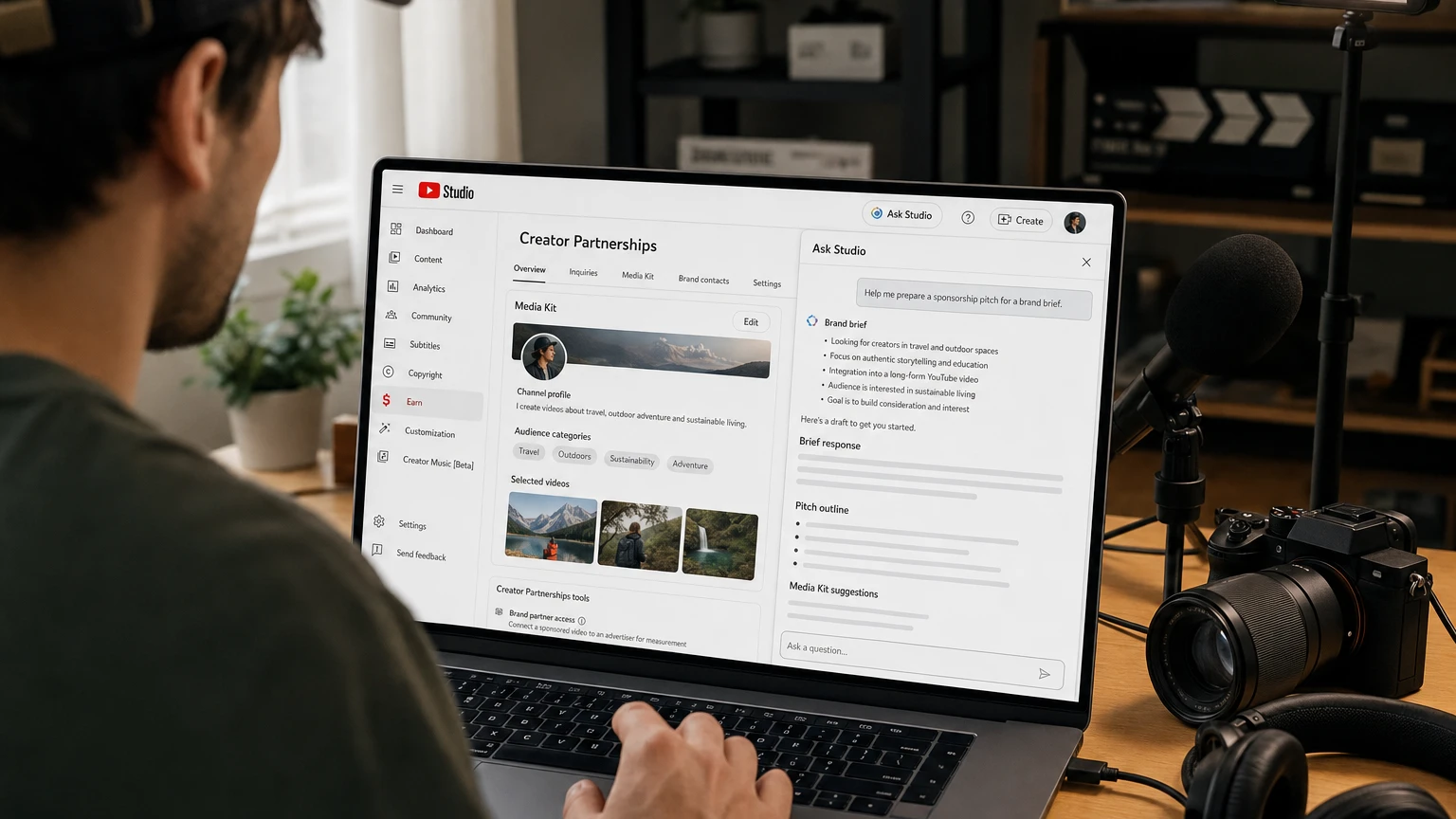
YouTube plans to add AI-assisted sponsorship-pitch tools to Ask Studio, giving creators help with advertiser briefs, proactive proposals and Media Kit customization inside YouTube Studio.
The company announced the additions on September 23, 2026, during its Made On YouTube event. It said Ask Studio will soon be able to draft tailored responses to brand briefs, assemble proactive pitch materials and suggest ways to adapt a creator’s Media Kit to a brand’s objectives.
The emphasis is on soon. YouTube did not provide a release date, market-by-market schedule or detailed eligibility rules for the new commercial functions. Ask Studio already exists as an AI assistant for ideas, audience trends and channel analysis, but its current help documentation does not yet describe the sponsorship-pitch features as generally available.
The announcement therefore is not the launch of an autonomous sales agent that negotiates and closes deals for creators. It is a plan to move more of the work surrounding sponsorships—including discovery, brief review, pitch preparation, audience data, reporting and paid promotion—into the Google and YouTube advertising ecosystem.
What is new, what is live and what remains in testing
| Feature | What it does | Status |
|---|---|---|
| Ask Studio pitch assistance | Helps draft responses to advertiser briefs, develop proactive pitch materials and tailor a Media Kit to a brand’s goals. | Coming soon; no firm release date announced. |
| YouTube Creator Partnerships | Lets eligible creators receive campaign inquiries, set suggested rates, maintain a business contact and become discoverable to brands. | Available in supported markets, with features varying by country and account. |
| Creator Media Kit | Packages channel statistics, audience information, branded-content examples and selected videos into a customizable report. | Available to YouTube Partner Program creators; the current Media Kit workflow is desktop-based. |
| Brand partner access | Connects a sponsored video to an advertiser so the advertiser can see performance data and, when rights permit, use the video in advertising. | Available, including code-based access for eligible YPP creators. |
| Creator partnerships boost | Allows advertisers to run organic creator videos in supported Google Ads campaigns. | Available, but advertisers remain responsible for obtaining sufficient usage rights. |
| Dynamic brand segments | Places sponsorship segments into as many as 20 long-form videos, with regional targeting and a direct-response product shelf. | YouTube says it is continuing to test and develop the feature. |
YouTube also said it would invest hundreds of millions of dollars in incentives for agency partners. It did not publish a breakdown of those incentives, but the commitment shows that the company is working on the advertiser and agency side of the market as well as creator-facing tools.
Ask Studio will prepare pitches, not negotiate the deal
YouTube’s existing Creator Partnerships system already provides much of the structure around the proposed AI assistance. Eligible channels can receive campaign inquiries under the Earn section of Studio, specify suggested prices for long-form videos and Shorts, and add an agent or manager as a secondary business contact.
According to YouTube’s current Creator Partnerships documentation, an inquiry can include the brand’s identity, campaign goals, deliverables, talking points, product information and an amount the creator could potentially earn. YouTube explicitly warns that the displayed amount comes from the advertiser and should not be confused with a final offer.
If a creator marks an inquiry as interesting, YouTube shares the creator’s contact details so the advertiser can begin direct discussions. The creator then negotiates and signs an agreement with the brand and is paid by that brand. YouTube provides the marketplace and workflow but is not the creator’s counterparty in a standard inquiry.
The forthcoming Ask Studio functions would sit before that negotiation. They could help a creator turn a brief and channel data into a more relevant opening proposal, but they would not decide the final price, approve contract terms or guarantee payment.
The distinction matters because much of the value of a sponsorship depends on details that cannot be inferred from a generic brief. A video integration posted to a creator’s existing audience is a different commercial product from a video that the advertiser can edit, distribute internationally or run repeatedly as paid media.
Media Kits and channel data become part of the pitch
YouTube’s Media Kit already gives Partner Program creators a downloadable report containing channel metrics and audience information. It can include a channel biography, key statistics, audience and shopping categories, demographics, branded-content examples and selected top videos.
Creators can customize parts of that report, including which videos and audience categories appear. Ask Studio’s proposed role is to recommend changes for a particular advertiser instead of forcing a creator to send the same generic document to every prospective sponsor.
That could be especially useful for channels without a dedicated sales team. A technology creator, for example, might emphasize business-software videos and relevant audience categories for one proposal, then foreground consumer-electronics coverage for another. The underlying data may be the same, but the commercial case is different.
Digiday’s post-event reporting similarly identified pitch preparation, reporting and deal-closing support as potentially valuable to creators who do not have managers or sales staff. The practical benefit will depend on whether Ask Studio produces specific, credible proposals rather than formulaic text that brands receive from many channels.
Reporting and paid promotion make usage rights more important
After a sponsored video is published, an eligible creator can generate a code that connects the video to the advertiser’s Google Ads account. The brand can then see performance information and use the video with creator partnerships boost if that use has been agreed upon.
YouTube’s brand partner access documentation says the information shared can include viewer demographics, watch time, retention, engagement and other public and nonpublic video-level metrics. A creator can remove the association later, ending access to nonpublic metrics and disabling promotion through creator partnerships boost for that association.
Removing platform access later is not a substitute for defining the brand’s rights in writing. YouTube and Google Ads documentation both tell advertisers and creators that sufficient video-usage rights may require a separate agreement.
Creators evaluating a deal should therefore distinguish between:
- Publication rights: Permission to include the sponsorship on the creator’s channel.
- Measurement access: Permission to view nonpublic performance and audience information.
- Paid-media rights: Permission to use the creator’s video, channel identity, face or voice in an advertising campaign.
- Editing rights: Permission to alter the video, add calls to action or create shortened versions.
- Duration and territory: How long the brand can use the material and where the ads may run.
A creator may reasonably charge more when a brand wants extensive paid-media usage than when it only wants an organic sponsorship. The Ask Studio proposal should reflect that distinction rather than collapsing every permission into one headline fee.
Why YouTube wants more of the sponsorship workflow
Creator advertising is becoming a larger, more formal part of media buying. The Interactive Advertising Bureau’s latest spending report projected that U.S. creator advertising would reach $44 billion in 2026, up from an estimated $37 billion in 2025.
Much of the sponsorship process still takes place through email, spreadsheets, external media kits, agency systems and separate analytics reports. Bringing those functions closer to Studio gives creators fewer tools to manage while giving advertisers a clearer route from creator discovery to measurement and paid distribution.
YouTube began laying out that strategy earlier in 2026 when it renamed BrandConnect as Creator Partnerships and described a centralized platform spanning YouTube Studio, Google Ads and Display & Video 360. The company said the advertiser-facing system uses Gemini to assist with creator discovery across a pool of more than 3 million YouTube Partner Program creators.
The September announcement extends that automation toward the creator’s side of the transaction. Brands can use platform data to find channels, while creators will be able to use Ask Studio to package their ideas and audience information into a pitch.
YouTube also benefits when an organic sponsorship becomes an advertising asset. Creator partnerships boost lets a brand use the creator’s video in campaigns across supported Google Ads products, linking sponsorship budgets more closely to Google’s advertising infrastructure.
What creators should settle before sharing access
AI can reduce blank-page work, but it cannot determine whether a proposed deal is fair. Before accepting a campaign or enabling brand partner access, a creator should ensure that the written agreement addresses:
- Deliverables: The number, format, duration and publication schedule of videos, Shorts, posts or live appearances.
- Compensation: The base creative fee, any performance incentives and additional charges for paid-media usage.
- Usage period: The dates on which the brand may promote or reuse the content.
- Territory: The countries or regions in which the campaign can run.
- Exclusivity: Which competitors are covered and how long any restriction lasts.
- Revisions: How many changes are included before further fees apply.
- Editing and likeness rights: Whether the advertiser may alter the work or reuse the creator’s name, face and voice.
- Data access: Which performance information the brand needs and when access will end.
- Cancellation and payment: What is owed if the campaign is delayed or canceled after production begins.
Creators should also verify who is requesting access. Brand partner access can be used by a brand or an agency acting for that brand, and the permissions can expose nonpublic channel information as well as enable paid promotion.
Availability remains less clear than the announcement suggests
YouTube says creators generally need to be at least 18, participate in the YouTube Partner Program, live in a supported market and have no active Community Guidelines strikes to receive the Creator Partnerships tab.
Its official pages currently give different market counts. The September 23 announcement says Creator Partnerships is available in 20 countries, while the U.S. help page lists 24 countries and regions. YouTube also says features can vary by market.
For an individual creator, the practical test is whether Creator Partnerships appears under Earn in Studio and which features are visible there. Creators should not assume that access to Ask Studio automatically includes the forthcoming sponsorship-pitch functions.
Turning off additional channel-insights sharing does not necessarily make a creator invisible to brands. YouTube says an eligible channel may still be discoverable and receive inquiries without that setting enabled. Creators who want to leave the discovery and outreach system entirely must follow YouTube’s separate opt-out process.
What happens next
The most important missing detail is the release schedule for Ask Studio’s commercial tools. YouTube has not said whether the functions will launch globally, reach all eligible Creator Partnerships users at once or begin as a limited experiment.
It is also unclear how much control creators will have over the channel data included in each AI-assisted pitch, whether proposal formats can be exported for use outside Studio and how distinctive the generated materials will be when many creators respond to the same brief.
Brand adoption will ultimately determine the impact. The tools will be more useful if advertisers consistently send detailed briefs, review proposals in Creator Partnerships and use the reporting workflow. They will be less transformative if creators still have to duplicate every conversation through email and agency portals.
Even with those unanswered questions, the direction is clear: YouTube wants to become more central to how sponsorships are found, pitched, measured and promoted. For independent creators, that could remove meaningful administrative work. It does not remove the need to price usage rights, evaluate the advertiser and protect the audience relationship on which the deal depends.
Make YouTube smarter with NextWatch AI
Use AI search, smarter discovery, playback tools and speed testing directly in your browser.
Add NextWatch AI to Chrome ↗